6 Aug, 2026

Petfood Palatability: Why Replacing Meat Is More Than Replacing Protein

The Friday Conversation · No. 3
Palatability  ·  Alternative Proteins  ·  Petfood

Meat Is More Than Protein

Perhaps meat was never just an ingredient. It is a biological language that every alternative protein must eventually learn to speak.
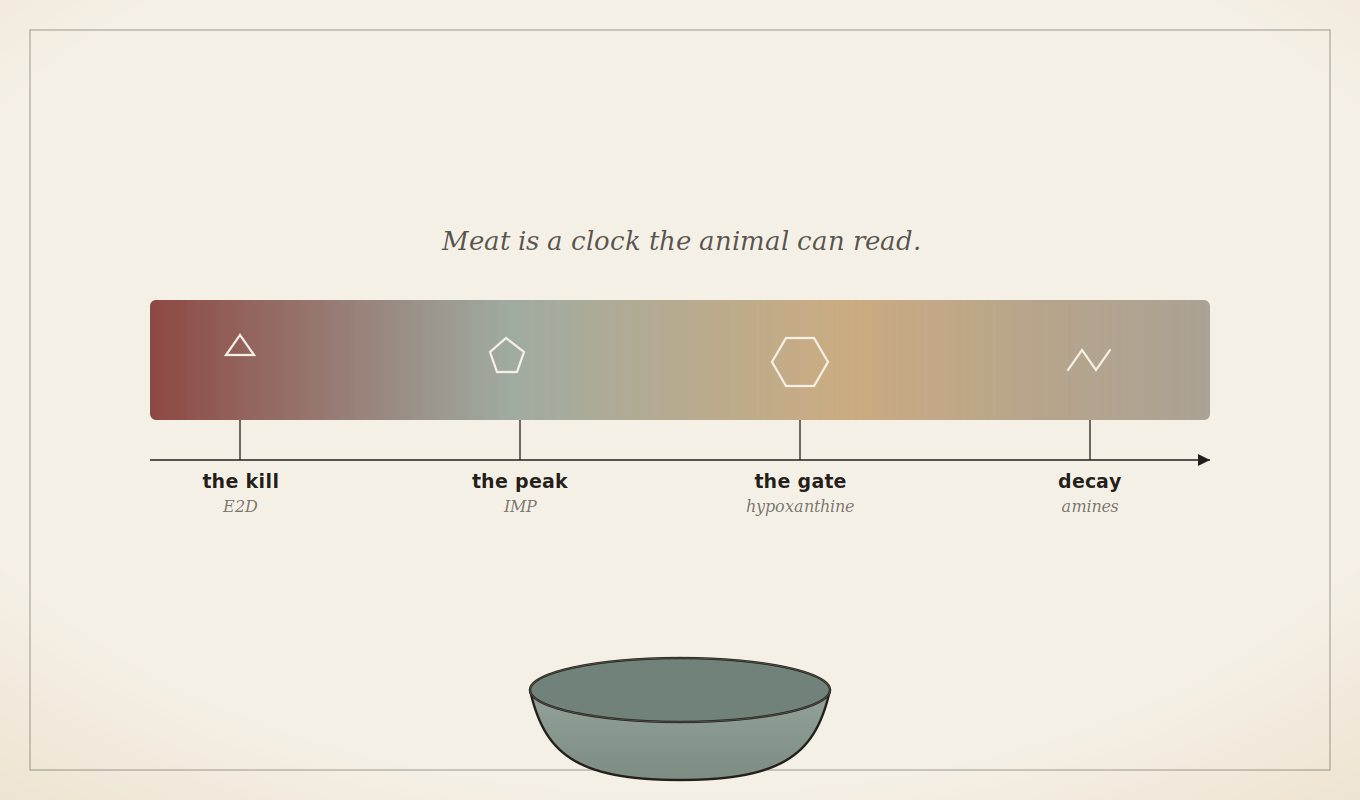
A freshness-clock timeline: the biochemical stages meat passes through after death, from the fresh-kill signal to spoilage.
Meat read as a clock: the fresh-kill signal, the umami peak, the bitter gate, and the controlled descent into spoilage.

Stand near a barbecue with your eyes closed and you can name what is cooking. Chicken smells like chicken. Lamb smells like lamb. Salmon announces itself across a garden, and beef is unmistakable long before it reaches the plate. Nobody finds this remarkable, because everybody can do it. It is one of those competences so ordinary that we never stop to ask how it works.

So ask it. Why does lamb smell like lamb and not like beef?

The comfortable answer is that they are different animals, which is true and explains nothing. Here is the answer that should unsettle anyone whose job is to rebuild meat from something that was never an animal at all: the difference you are smelling is almost entirely not in the protein. Strip a piece of chicken and a piece of beef down to their lean muscle, cook them bare, and they converge. The heat of cooking on lean tissue produces a meaty aroma that is remarkably species-neutral, the generic smell of cooked flesh, and a blindfolded taster would struggle to tell them apart. What makes chicken smell like chicken lives somewhere else.

It lives in the fat. And not the fat you can see and trim, but the fat woven invisibly into the cell membranes: the phospholipids. Remove the phospholipids from beef and its flavour changes markedly; leave the visible marbling and remove nothing else, and far less is lost. The species signature is a membrane phenomenon. The identity of meat resides less in its muscle proteins than in the chemistry of the lipids surrounding them. Lamb carries its identity in branched-chain fatty acids that beef does not use for flavour at all. Pork can carry a note that is, quite literally, a steroid dissolved in fat: boar taint, the reason most male pigs are castrated, is androstenone lodged in the adipose tissue. Chicken loses its chicken-ness the moment you wash the polar compounds out of its adipose tissue. And none of it speaks until fire arrives: raw meat is weakly flavoured, faintly metallic, faintly of blood, a reservoir of precursors waiting for heat to convert them. A substantial proportion of a cooked meat's characteristic aroma arises from lipid oxidation products and their interactions during heating, rather than from the muscle proteins themselves.

The lean is nearly the same across species. The signature was always in the fat.

I open here, at the grill, for the fastest way into the thing this whole conversation turns on. In the second of these Friday conversations I wrote about a single molecule, the one a cat reads off a fresh wound before it has taken a bite. That was the smell of the kill. This is the smell of the fire. Meat speaks in more than one aroma, one from the wound and one from the flame, and in both of them the protein is silent. Which raises the question the alternative-protein transition has mostly declined to ask out loud: if the thing that makes meat taste of anything at all was never the protein, what exactly are we matching when we match the protein?


WHAT WE HAVE REPLACED, AND WHAT WE HAVE NOT

Let me grant the strong version first. It is true, and the argument does not work without it.

What the alternative-protein industry has largely succeeded in replacing is nutrition. We now know how to formulate diets that deliver complete amino acid profiles, adequate digestibility and, with appropriate supplementation, the vitamins and micronutrients an obligate carnivore requires. That is no small achievement. It represents decades of careful nutritional science, and I have spent enough of my own life on protein hydrolysis to refuse to wave it away. The lysine in a pea is the same lysine as the lysine in a muscle; it is a small, defined molecule and it does not carry a passport. On the nutrient certificate, the substitution is honest and complete.

What remains much less certain is everything beyond nutrition.

We are making progress in reproducing the broad savoury character of meat through hydrolysed proteins, fermentation products, yeast extracts and carefully designed flavour systems. Yet recreating the aroma of meat is not the same as recreating the identity of meat. A cooked chicken, a grilled lamb chop and a roasted beef steak all announce themselves long before they are tasted, each carrying a distinctive chemical signature that evolution has written into their lipids and that cooking merely reveals. We understand fragments of that language. We are still far from speaking it fluently.

A legume may provide the vocabulary of nutrition. Meat provides the grammar of recognition.

Harder still is the question of species recognition. We know remarkably little about how a cat weighs one prey species against another, or how many cues must be present, and in what combination, before the brain concludes simply: this is food. In the last of these conversations we met one such cue, a blood-borne signal shared across the whole predatory lineage. But that signal says kill, not chicken. The cues that carry species identity, and the number of them a diet must satisfy, remain largely unmapped. The science is moving. The map is still mostly blank.

Beyond recognition lies an even larger uncertainty. A bowl is emptied not because a formulation is nutritionally complete, but because an animal chooses to return to it, day after day. That decision emerges from a conversation between aroma, taste, texture and the physiological consequences of eating. Preference is learned, reinforced, and sometimes abandoned. We understand parts of that process. We do not yet understand the whole.

Seen in this light, the challenge facing alternative proteins is changing. It is no longer simply to replace the nutrients found in meat. Increasingly, it is to reproduce the biological functions that meat performs. Nutrition may be the first milestone. It is unlikely to be the last. The future belongs not to formulations that merely analyse like meat, but to those that are recognised, accepted and remembered as food by the animal standing at the bowl.

And to see how far that reaches, you have to stop treating meat as a thing with a fixed composition, and start watching what it does when it is left alone.


Movement I

MEAT THAT WRITES ITSELF

Here is the fact that ought to change how a formulator looks at a data sheet, and almost never does. A cut of meat is not finished when the animal dies. It is barely begun.

In the hours and days after death, the tissue sets about digesting itself. No one adds an enzyme; the enzymes were always there, folded away inside the living cell, kept apart from the structures they would otherwise destroy. Death removes the partition. As the muscle runs out of oxygen and turns acidic, drifting down toward a pH near 5.5, the little membrane-bound compartments called lysosomes, the cell's own recycling bins, begin to break open. Out spill the cathepsins, enzymes that are most active in exactly the acid conditions that dying muscle creates. A second family, the calpains, goes to work on the structural proteins and loosens the meat toward tenderness. The cathepsins and the peptidases that follow them do something subtler and, for our purposes, more important: they carve the long proteins into short peptides, and the short peptides into free amino acids.

This is where much of meat's flavour is actually made. Aging is not storage. It is a slow, self-directed hydrolysis, the tissue quietly cleaving its own proteins into the small, taste-active fragments a carnivore is tuned to. Amino acids that are barely present in fresh muscle, tyrosine, phenylalanine, threonine, tryptophan, rise into detectability as the enzymes run. Some of them read as sweet, some as bitter, and the acidic and sulphur-bearing ones, glutamate and aspartate, cysteine and methionine, carry the deep savour we call umami. The meat that a cat would choose is, in a real sense, meat that has been cooking itself without heat.

Aging is not storage. It is the meat quietly cleaving its own proteins into the language of savour.

Now set that beside a specification. When we match the amino acid profile of muscle, we are matching a photograph of a moving thing. The certificate records what the tissue contained at the instant it was sampled, as though composition were the point. But the carnivore did not evolve to eat a composition. It evolved to eat a process, a tissue whose free amino acids and peptides and nucleotides are still being generated on their own clock, arriving in a sequence and a proportion that the animal's chemistry learned to read across millions of years of eating exactly this.

A legume hands you a number, fixed and honest, printed on a page. Muscle hands you an engine that is still running. You can match the number precisely and never build the engine, because the engine was never in the protein content. It was in the enzymes that came free with the animal, the ones that keep working after the animal is gone.

A legume gives you a number on a certificate. Muscle gives you an engine that is still running.

And the engine does not stop at flavour. The same self-digestion that fills fresh meat with savour keeps going, and where it goes next is the second half of this story, because the clock that ripens meat is the same clock that will eventually spoil it. Before we follow it there, though, we should look at what the animal is reading while the meat is still at its best, the signal that sits at the very peak of freshness and begins, quietly, to fade from the first hour onward.


Movement II

THE CLOCK THE TONGUE CAN READ

There is a second clock running alongside the first, and where the enzymes of self-digestion were slow, this one is fast and almost violent in its opening moments. It concerns the nucleotides, and it is the taste-side companion to the smell-side signal I wrote about last time.

At the instant of death, the muscle is still charged with adenosine triphosphate, ATP, the molecule that powered it in life. With the animal gone and the oxygen with it, that ATP begins to fall apart along a fixed staircase: to ADP, to AMP, and then, within the first day or two, to a compound called inosine monophosphate, IMP. And IMP is not a waste product. It is one of the most powerful savoury molecules in all of food, the nucleotide that carries umami, the very compound the tongue of an obligate carnivore is built to detect. In the first hours after death the meat is quietly filling with the taste of savour. This is the peak. This is freshness at its most delicious, and it is why a signal on the taste side and a signal on the smell side both point, in a fresh kill, to the same conclusion.

But the staircase does not stop at IMP. It keeps descending, only more slowly, because the enzyme that breaks IMP down is the rate-limiting step, and so IMP lingers at its peak for a while, a plateau of deliciousness, before it gives way. When it gives way it becomes inosine, and then hypoxanthine, and hypoxanthine is bitter. The savour fades and a faint bitterness rises in its place. Long before any bacterium has done its work, long before the meat has begun to rot in any sense a nose would recognise, the taste has already started to tell the animal that the best moment has passed.

IMP is the taste of freshness at its peak. Hypoxanthine is the taste of that peak already passing.

This is the taste-side clock, and the tools of fish science measure it directly. The freshness of fish is graded by a number, the K-value, that is simply the ratio of the spent compounds, inosine and hypoxanthine, to the whole family of ATP breakdown products. A low K-value is a fresh fish; a high one is a fish whose clock has run down. A carnivore does not carry a laboratory, but it carries the same reading in its mouth. The E2D of the last conversation was freshness announced at the very first instant, ab initio, off the wound. The nucleotide clock is freshness measured across the hours that follow, the savour rising to a peak and then, molecule by molecule, beginning to leave. Between them, smell and taste, the animal has a remarkably precise clock on how long ago something died.

And this is where one ingredient proves the entire argument of this essay, more plainly than any reasoning could.

Consider liver. Ask anyone who has fed cats and dogs which single ingredient they find hardest to resist, and liver will be near the top of every list. Cats can be so taken with it that they will overeat it against their own interest. On a protein specification, liver is unremarkable, roughly comparable to muscle, sometimes lower. If protein were the thing an animal was chasing, liver would be ordinary. It is not ordinary. It is close to irresistible, and the reason is precisely the vocabulary this essay has been assembling.

Liver is not muscle at rest. It is the body's most metabolically active organ, a chemical factory that never idles in life, and it is therefore dense in exactly the compounds a carnivore is tuned to read: nucleotides in abundance, free amino acids and short peptides, the blood that carries the heme and its metallic note, and the fat that carries so much else. Everything the tongue and nose of a carnivore evolved to prize is concentrated in that one organ, not because it holds more protein, but because organ function itself, the ceaseless traffic of a living liver, leaves its signature in the tissue. The palatability of liver is metabolism made edible.

Liver is not more protein than muscle. It is more of everything the protein was never carrying.

There is a quiet lesson folded inside this for anyone tempted to think the answer is simply to add the missing molecules back. Some of what makes the organ precious does not survive the factory. The heat of processing degrades the very taurine and the B vitamins that made the raw organ so complete for a cat, which is why they must be added back as supplements at all. We are already, without quite admitting it, conceding the point: the raw tissue delivered something that our processing removes and then reconstructs in part. Nutrition we can rebuild. Whether we have rebuilt the whole of what the animal was reading is a different and far less settled question.


Movement III

WORDS ONLY FIRE CAN SAY

Everything so far has been about what the raw tissue already holds, or makes for itself: the fat woven into the membranes, the peptides carved out by the cell's own enzymes, the nucleotides rising and falling on their clock. But a large part of meat's language does not exist in the raw material at all. It has to be written, and the pen is heat.

Return to the barbecue we started at. The raw chop on the counter is faint, a little metallic, faintly of blood, and almost nothing like the thing that will fill the garden twenty minutes later. What happens in between is chemistry of real complexity, and it has a name. When the amino acids and the reducing sugars in the meat are brought together at temperature, they enter the Maillard reaction, a cascade of hundreds of steps that generates hundreds of new molecules that were simply not present before. Alongside it runs Strecker degradation, breaking amino acids into their own aromatic fragments, and alongside that the breakdown of the lipids, throwing off volatile pieces of the fat. These are not small effects. The characteristic flavour of cooked meat is very largely a creation of these thermal reactions. The roast, the sear, the brown crust: this is a vocabulary spoken only by fire, and the raw tissue is merely the reservoir of words waiting to be said.

Here, at last, is a part of the language where the alternative-protein project is on strong ground, and I want to say so plainly. The Maillard reaction does not, in principle, care where its amino acids and sugars came from. Give it the free amino acids of a fermented biomass and the reducing sugars of a plant, hold them at the right temperature, and it will brown and roast and generate savour on a meat-free substrate as readily as on a muscle. Much of the industry's real success in savoury flavour lives exactly here, in the deliberate use of thermal reactions and the hydrolysates that feed them. If any part of meat's language can be spoken fluently by a plant or a ferment, it is this one.

The Maillard reaction does not ask where its ingredients were born. This is the part of the language a plant can learn to speak.

But notice the boundary, because it is precise, and it takes us straight back to the grill. The Maillard reaction supplies the meaty. It does not, by itself, supply the chicken, or the lamb, or the beef. The generic roasted savour is shared; the species identity rides on the lipid substrate underneath it, on those branched-chain fatty acids and species-specific phospholipids that the heat is acting upon. Cook two different meats and the Maillard chemistry is broadly the same in both; what differs is the fat it has to work with, and the fat is where the animal's name is written. So heat can give a fungal kibble the word for cooked. Whether it can give it the word for a particular prey is a harder question, and it returns us, every time, to the fat.

There is a second, quieter point in this for the formulator, and it connects the two halves of the essay. Some of the most meaty of all the thermal compounds are built, in part, from the very nucleotides we were just discussing. The IMP that carries umami on the tongue is also a precursor that heat can convert into some of the most potent roasted, meaty aromas known. The freshness clock and the fire are not separate systems. The molecule that signals a fresh kill to the taste is the same molecule that, under heat, helps write the smell of the roast. Meat's vocabulary is not a list of independent words. It is a web, in which the same molecule can mean one thing to the raw tongue and another thing entirely once the fire has spoken it.


Movement IV

CONTROLLED SPOILAGE

Follow the clock past its best moment and it does not simply stop. The same self-digestion that filled the fresh meat with savour keeps running, and now a second cast of characters arrives: the bacteria. What they do next is, on the surface, the story of rot. Read more closely, it is one of the most interesting things in this whole essay, for it is also the story of some of the most prized foods we make.

When microbes settle into meat, they set about the free amino acids that self-digestion so helpfully produced, and they strip the acid group from them. This is decarboxylation, and its products are the biogenic amines, each one traceable to the amino acid it came from: histidine becomes histamine, tyrosine becomes tyramine, lysine becomes cadaverine, ornithine becomes putrescine. The names alone tell you which way this is heading. Cadaverine and putrescine are the smell of decay, and their rise is a reliable index that decomposition has begun.

But the story is not as simple as good versus spoiled, and this is the part worth slowing down for. Some of these amines are genuinely aversive, even dangerous: histamine at high levels is the cause of scombroid poisoning, and tyramine and phenylethylamine can push blood pressure and trigger headaches. Some are close to neutral, present at low levels in perfectly healthy tissue as part of the ordinary chemistry of living cells. And some, in the right food at the right concentration, are not spoilage at all. They are flavour. The depth of an aged cheese, the tang of a fermented sausage, the savour of a fish sauce that has stood for a year: these are, in significant part, the taste of the very same amines, produced by the very same decarboxylation, that in another vessel we would have called rot.

Aged cheese and rotting fish share a chemistry. The only difference is who was invited.

Here is the thing that ought to stop a formulator in their tracks. The enzymes that carry out this decarboxylation are found in the microbes of spoilage and in the microbes of fermentation alike. The reaction is the same. The products are the same family. What separates the cheese from the rot is not the chemistry but the control: which organisms were present, at what temperature, for how long, under what salt and what acid. Choose the culture and hold the conditions, and you get the sausage. Let the wild flora arrive on their own terms, and you get the bin.

Fermentation, in other words, is spoilage you chose the microbes for. Rot is spoilage that chose its own.

Fermentation is spoilage you chose the microbes for. Rot is spoilage that chose its own.

I set this at the end of the essay, and not as a flourish, because of where the alternative-protein industry actually stands. A great deal of the most serious work in the field is fermentation: mycoprotein grown in tanks, precision-fermented ingredients, biomass raised by cultures under tight control. The industry is already, and expertly, working the far end of the very freshness gradient this essay has walked. It has spent its skill on the controlled end, on safety and consistency and the avoidance of the aversive amines, which is exactly right and not to be second-guessed.

The question I want to leave in the room is subtler than safety. Meat is not palatable because it sits at one fixed point on this gradient. It is palatable because a carnivore evolved to read the whole of it: the fresh-kill signal at the top, the umami of the peak, the first bitter hint of the turn, and yes, in aged and cured and fermented forms, some of the controlled notes of the descent. If we are learning to build proteins by fermentation, we are already speaking the last dialect on the gradient. The unanswered question is whether we are shaping it only away from what is dangerous, or also toward what an animal would recognise as the deep, aged, savoury language it has always known food to speak.


THE WHOLE ENSEMBLE

Stand back now from the gradient we have walked, and look at the whole of it at once.

At the top is the fresh kill, and the blood-borne molecule a predator reads off the wound in the first instant. Then the savour rising as the nucleotides climb to their peak, the umami of a thing at its freshest. Then the first faint bitterness as that peak begins to pass, the taste telling the animal the clock has started. Beneath all of it, from the very beginning, the fat and its phospholipids, carrying the name of the species in molecules no scale will weigh. Through the middle, the meat quietly digesting itself, cathepsins carving savour out of structure. And at the far end, the controlled descent, the aged and fermented notes that are spoilage tamed and made delicious. This is not a list of ingredients. It is an ensemble, and every part of it is playing at once.

That is the word I have been circling for three of these conversations. Meat is not a substance. It is an ensemble, a whole orchestra of signals sounding together, and a carnivore did not evolve to eat any one of them. It evolved to hear the chord.

And an ensemble is more than the sum of its players. This is the part the specification can never hold, because it is not written in any one component but in the way they sound together: the proportion, the timing, the interference of one note against another. You could fill every chair on the stand, source each molecule on the list and set it in its place, and still not have meat, because meat was never the collection of its parts. It was their playing together. The chord is not the notes.

And this is the thing I most want to leave with anyone rebuilding meat from something that was never an animal. When we replace meat, we do not replace the orchestra. We replace some of the players. We are very good now at the nutrition, which is the section that keeps the animal alive; we are increasingly good at the roasted, Maillard savour, which any substrate can be taught to sound. But the fat that carries the species, the nucleotide clock, the self-made peptides, the deep controlled notes of the aged descent, many of these chairs are still empty, or filled by a player reading from a different score.

Here is the question that keeps me up, and that I do not think the industry has yet asked itself squarely. An incomplete orchestra is not simply a quieter orchestra. Leave out the strings and you do not get the same symphony played softly; you get a different piece, and sometimes a discordant one. The parts that are present, sounding without the parts that are absent, can be worse than silence, because the animal is not comparing our formulation to nothing. It is comparing it to a chord it has known for forty million years. A bowl that delivers perfect nutrition and half the ensemble may not read to a cat as incomplete meat. It may read as something that is trying to be prey and failing, which is a harder thing to forgive than a food that never pretended at all.

I do not say this to discourage the project. I say it because the project is worth doing well, and doing it well means being honest about what is actually on the stand. Nutrition was never going to be the whole score. It was the first section to learn its part. The work now is the rest of the ensemble: to find which of the empty chairs matter most to the animal, and in what combination, and whether the players we do have are sounding in tune with one another or merely sounding.

Perhaps meat was never just an ingredient. It was an orchestra, and the animal at the bowl has been listening to the whole of it all along. The question for the next diet is not whether it can analyse like meat. It is whether, when the animal leans in to listen, the chord rings true.

Dr. rer. nat. habil. Dr. Seronei Chelulei CheisonLangwedel, Niedersachsen

Sources drawn on for this essay

  1. Mottram, D.S. (1998). Flavour formation in meat and meat products: a review. Food Chemistry 62(4): 415–424. doi:10.1016/S0308-8146(98)00076-4
  2. Mottram, D.S. & Edwards, R.A. (1983). The role of triglycerides and phospholipids in the aroma of cooked beef. Journal of the Science of Food and Agriculture 34(5): 517–522.
  3. Toldrá, F. & Flores, M. (1998). The role of muscle proteases and lipases in flavor development during the processing of dry-cured ham. Critical Reviews in Food Science and Nutrition 38(4): 331–352. doi:10.1080/10408699891274237
  4. Howgate, P. (2006). A review of the kinetics of degradation of inosine monophosphate in some species of fish during chilled storage. International Journal of Food Science & Technology 41(4): 341–353. The freshness K-value derives from Saito, T., Arai, K. & Matsuyoshi, M. (1959), Bulletin of the Japanese Society of Scientific Fisheries 24: 749–750.
  5. McGrane, S.J., Gibbs, M., Hernangomez de Alvaro, C., Dunlop, N., Winnig, M., Klebansky, B. & Waller, D. (2023). Umami taste perception and preferences of the domestic cat (Felis catus), an obligate carnivore. Chemical Senses 48: bjad026. doi:10.1093/chemse/bjad026
  6. Gassenmeier, K. & Schieberle, P. (1994). Formation of the intense flavour compound trans-4,5-epoxy-(E)-2-decenal in thermally treated fats. Journal of the American Oil Chemists’ Society 71(12): 1315–1319. doi:10.1007/BF02541347
  7. Watson, P.E., Thomas, D.G., Bermingham, E.N., et al. (2023). Drivers of palatability for cats and dogs: what it means for pet food development. Animals 13(7): 1134. doi:10.3390/ani13071134
  8. Prester, L. and the Frontiers review of biogenic amines in seafood (2012), Frontiers in Microbiology 3: 188, doi:10.3389/fmicb.2012.00188; on fermentation as controlled decarboxylation, see the review of biogenic amines in fermented foods (2024), Heliyon, doi:10.1016/j.heliyon.2024.e25553.

Dr. rer. nat. habil. Dr. Seronei Chelulei Cheison is the founder and Chief Executive Officer of Sinonin Biotech GmbH, a biotechnology company focused on alternative protein and palatability enhancer innovation and application for petfood formulations. He formerly led alternative protein and palatant development projects at the Mars Petcare Global Innovation Centre in Verden, and spent close to two decades in academic research on enzymatic protein hydrolysis, holding a doctorate from Jiangnan University and a habilitation from the Technical University of Munich.

Sinonin Biotech GmbH is a partner in two consortia funded under the Circular Bio-based Europe Joint Undertaking: ZEST, on fungal fermentation of agricultural residues, and PROSCALE, on scalable microbial protein ingredients, which runs from September 2026 to August 2030.

Co-funded by the European Union under Grant Agreement No. 101157382 (ZEST) and Grant Agreement No. 101288362 (PROSCALE). Views and opinions expressed are however those of the author only and do not necessarily reflect those of the European Union or CBE JU. Neither the European Union nor the CBE JU can be held responsible for them.

30 Jul, 2026

Petfood Palatability and the Fresh-Kill Signal Cats Read as Prey


The Biological Signal — The Friday Conversation No. 2


The Friday Conversation · No. 2
Palatability  ·  Alternative Proteins  ·  Petfood

The Biological Signal

Why the cat at the bowl is not smelling meat. It is smelling a fresh kill, and the single molecule that tells it so is one the flavour industry has spent twenty-five years trying to bottle.

An editorial illustration: aroma rising from a bowl resolving into the skeletal structure of the molecule trans-4,5-epoxy-(E)-2-decenal.
The aroma rising from the bowl, resolved into a single molecule: trans-4,5-epoxy-(E)-2-decenal.

Cut a finger and bring it to your nose, and you will recognise at once a smell you have never been taught: sharp, metallic, faintly like wet iron. You did not learn it. It arrived with you. And it has a name, a single molecule, one of some thirty that gas chromatography can pull out of a drop of blood, and the only one your nose truly needs.

For a human being that smell is a curiosity, occasionally an alarm. For an obligate carnivore it is not a smell at all. It is an instruction.

For decades the petfood industry has spoken of “meat flavour” as though a cat crossed the kitchen because it enjoyed the taste of meat, the way a person enjoys the taste of beef. That is a comfortable anthropomorphism and it is not what evolution built. The cat is not a small person with fur. It is a predator whose sensory apparatus was shaped by a single recurring problem, asked over millions of years and millions of kills: is this prey fresh enough to be worth eating?

That question is answered long before anything reaches the tongue. It is answered in the air.

I raise this now, and not as a curiosity, because the category is in the middle of the largest reformulation in its history. The industry is moving (under pressure from cost, from carbon, from supply, and from a genuine shift in what owners will buy) away from meat and toward alternative proteins: fungal biomass, single-cell protein, insect meal, and at the furthest edge, plant-based and outright vegan diets for animals that evolution designed around a carcass. I am not here to tell that movement it is wrong. Much of it is right, and some of it is overdue. I am here to name, precisely and early, the thing standing between it and the bowl.

Because the transition will not be decided by whether these proteins can nourish a cat. It will be decided by whether the cat recognises them as prey.

A word on how I mean to do it. In the first of these Friday conversations I set five questions on the table and closed none of them. This one moves differently (a single question, followed as far down as I can take it), but the discipline is the same. I do not intend to answer this one either. I intend to show you how deep it goes, name the people who could answer it, and leave it, on purpose, where a conversation can still reach it.

The cat is not a small person with fur. It is a predator asking one question: is this fresh enough to be worth eating?

The nose that threw things away

An omnivore’s senses are a compromise. They must find ripe fruit and reject unripe, detect sweetness and starch, weigh a hundred plant and animal foods against one another. The cat abandoned all of that. Somewhere on the way to obligate carnivory it lost the working sweet-taste receptor entirely: the gene is a pseudogene, a broken cassette, and it is why a cat is indifferent to sugar in a way no dog ever is. What the lineage saved on sugar it spent on meat. The equipment that survived is equipment for one job: to find, assess and commit to prey.

So when we sit down to reformulate that prey (to replace the animal tissue in the bowl with mycoprotein, with fermented biomass, with a protein a European hectare threw away), we are not merely swapping a nutrient. We are addressing a sensory system that was built, at the cost of everything it discarded, to detect the one thing we have taken out.

The molecule

When blood meets air, the fats within it begin to oxidise almost immediately. Lipid peroxidation is not exotic chemistry; it is the same family of reactions that turns fat rancid, running here in seconds rather than months. Among its products is an oxygenated aldehyde with an unwieldy name, trans-4,5-epoxy-(E)-2-decenal, mercifully shortened by the people who study it to E2D.

E2D is the character-impact compound of blood. Of the roughly thirty volatiles a machine finds in a blood sample, this is the one a trained human nose picks out as the metallic, blood-like note, a fact established not by the instrument, which nearly missed it, but by human panellists smelling the gas chromatograph’s output one peak at a time. It is extraordinarily potent. Human detection thresholds sit in the parts-per-trillion range; the mouse, for its own reasons, is more sensitive still.

And here is the detail that ought to reorganise how we think about the whole category: no open wound, no E2D. The molecule is not a property of meat. It is an event, with a clock. It appears when tissue is broken and blood meets oxygen (at the moment of the kill), and it is gone again as the chemistry moves on. It does not signal meat. It signals a fresh kill. What comes later, as flesh actually decays, is a wholly different and largely repellent set of volatiles. E2D is the top of the freshness curve, not the bottom of the rotten one.

It does not signal meat. It signals a fresh kill, and it is gone again before the meat has time to rot.

What the animals actually did

Between 2014 and 2017 a group of Scandinavian researchers did the experiment that turns this from chemistry into biology. They took pure E2D (no blood, just the single synthesised molecule) and painted it onto wooden logs, and gave it to captive predators. Siberian tigers, Asian and African wild dogs, South American bush dogs, later a pack of wolves. The animals sniffed, licked, bit, pawed and dragged the logs exactly as they did for a fresh kill. One molecule reproduced the response of the whole complex mixture. Present the same compound to a mouse and it does the opposite: avoidance, vigilance, retreat. The identical cue, read as dinner by the predator and as danger by the prey, across species that last shared an ancestor a very long time ago. The word the field uses is conserved, and it is the right one.

Now the honest edge of this, which the essay will not step around, because stepping around it is precisely the habit I am arguing against.

The tiger is a felid. The domestic cat is a felid. The lineage, the diet, the obligate carnivory are shared. It is a reasonable and probably correct inference that Felis catus reads E2D as the tiger does. But inference is not evidence, and I want to be exact about what I am and am not claiming. To the best of my search, no publicly published study has put a domestic cat in front of purified E2D, measured its investigation and its intake, and reported the number. I make the distinction on purpose. The great palatability houses run trials they never publish, and it is entirely possible the experiment has already been done behind a confidentiality wall and quietly priced into a product. What I can say is that it is not in the public record, not in the behavioural journals, which stopped at tigers, wolves and wild dogs; and not, I checked, in the flavour patents that first put a commercial value on this molecule, which rest their entire case on human tasters smelling the compound in water. The most commercially consequential species in the palatability business is absent from the one experiment that would matter most to it, at least anywhere the rest of us are allowed to read.

I would be glad to be shown the study I could not find. And if it truly is not there (if the number does not exist, or exists only where none of us can see it), then that absence is not a footnote. It is the conversation.

The most commercially consequential species in the whole business is missing from the one experiment that would matter most to it.

A word to the dog

Before anyone assumes this is a cat’s story alone: it is not. The clearest behavioural evidence for E2D comes from the dog family. The wolf, the domestic dog’s own ancestor, worked the scented logs as avidly as the tiger did, and three wild-dog species did the same.

E2D is not a feline signal. It is a carnivore signal, and the dog reads it plainly.

What differs is not whether the dog detects the kill, but how much rides on the detection. The dog is the better nose of the two, with more than twice the cat’s olfactory neurons, and it is an omnivore with the full five-taste palate, sweet included, and a working flexibility the cat traded away. It reaches acceptance by many roads. The cat reaches it by few: no sweet receptor, fewer taste buds, a narrower diet, a deeper neophobia. So the same molecule that is one appetite cue among several for the dog is, for the cat, closer to the whole case. I have told this through the cat not because the dog is unmoved, but because the cat is where a single wrong note is likeliest to end in a turned back and an untouched bowl. Solve the cat, the finickier customer, and you have cracked the hardest bowl in the business.

Why this is not another palatant story

The systems that carry the category today are genuinely good, and I will not pretend otherwise. Animal digests, hydrolysed proteins, the browning chemistry of cooking, these reproduce, with real skill, much of the flavour a cooked and digested meat delivers. They are the reason a modern coated kibble works at all, and I spent years of my own working life inside that toolkit. Nothing here displaces them.

But E2D is a different kind of message, and the difference is the point. A digest imitates cooked meat: the kitchen, the retort, the long warm chemistry of a meal. E2D imitates fresh prey: the wound, the moment, the kill. These are not two intensities of the same signal. They are two different sentences spoken to two different parts of the animal’s evolutionary memory: one about food that has been cooked, one about food fresh from the kill.

There is a practical consequence that formulators will recognise immediately. E2D is volatile and reactive; it would no more survive the heat of an extrusion barrel than a fragrance would survive a hot iron. You do not scent a shirt and then press it; you press it first and lay the scent on after. A signal like this could not be built into the dough. It would have to be delivered afterward (through the fat coat, the liquid palatant, the topcoat applied once the kibble had cooled), so that its message waited in the headspace the instant the bag was opened and the bowl was filled. Its job would not be nutrition. Its job would be the first sentence the animal reads before it has taken a step.

And is it? Is E2D, or some designed cousin of it, already sitting in a product on a shelf, doing exactly this? I do not know, and I will not pretend to. That is the honest edge of an outsider’s knowledge, and it is precisely the sort of thing I would rather ask in the open than guess at in private. If it is already there, then someone has been speaking the cat’s oldest language for years without saying so. If it is not, then the most potent word in that language is going spare.

The industry knew, and the regulator hesitated

None of this escaped the people whose business is flavour. More than two decades ago the flavour and fragrance house Givaudan patented the isomers of epoxydecenal specifically for their potency, in United States patents resting on the observation that the molecule’s handedness matters, that one optical form of the same compound carries more sensory punch than its mirror image. Even chirality, the difference between a left hand and a right, turns out to be something biology is reading. That is the level of detail the category has been prepared to pursue.

And yet the same molecule sits under a regulatory shadow. In the European Union, the flavouring 4,5-epoxydec-2-enal was assessed by EFSA and could not be cleared: it tested positive for genotoxicity in an in-vitro micronucleus assay, a result the follow-up in-vivo work confirmed in the liver, and the panel concluded it could not be evaluated as safe under the standard procedure. In 2017 it was removed from the EU list of permitted flavourings. That verdict was reached for human food, and petfood is a different regime with different exposures and different rules; one does not automatically carry to the other. But it is a caution written in ink, not pencil, and any honest account of E2D has to carry it too.

It is worth being exact about the two numbers involved, because they sit strikingly far apart. The signal a predator reads operates at the edge of physics: a cat’s fresh-kill cue is a matter of parts per trillion, picograms of the molecule in the air above the wound. The genotoxic flag, by contrast, was raised by feeding rats near-maximum-tolerated doses, in the region of three hundred milligrams per kilogram straight into the stomach, enough to leave necrosis in the liver. Between the concentration that carries the message and the concentration that does the damage lies a gap of many orders of magnitude, and the same chemical reactivity that lights up a genotoxicity assay in a dish is precisely what makes E2D a fleeting top-note in the world rather than a compound that lingers or accumulates. None of which clears it; the flag is real and I will not explain it away. But it does sharpen the question. The hazard was shown in a rodent liver, for a human additive, at a dose no palatant use would approach, in a species that is not the one eating the bowl.

Which leaves the honest account not with a verdict but with a gap in the evidence, and it is worth naming plainly. Is there a single published study of what E2D does in a cat, at the vanishing concentrations a cat would actually meet, rather than in a rat gavaged to its limit? If there is, I have not found it. And if there is not, then we are weighing a signal biology has used for millions of years against a hazard measured in the wrong species, by the wrong route, at ten orders of magnitude the wrong dose, and calling the balance settled. Is it?

Applied chemical ecology

Here is where the questions get harder, and I would rather leave them open than pretend I have closed them.

Modern palatant development, at its sharpest, is no longer flavour creation in the culinary sense, the art of making something taste nice. It looks more like applied chemical ecology: the deliberate use of signals evolution spent millions of years teaching an animal to obey. And if that is what the discipline has quietly become, then is the whole alternative-protein transition asking the wrong question of itself? We keep asking whether a fermented biomass can nourish a cat. Should we not be asking, first and far more urgently, whether it can convince one?

We keep asking whether a fermented biomass can nourish a cat. We should be asking whether it can convince it to eat.

Because a diet the animal refuses has an efficacy of zero, and the refusal is decided in the headspace above the bowl, in the first second, before a single requirement on the label has been tested.

Which brings the sharpest question to the table, the one that decides whether the vegan bowl is a biological dead end or merely an unsolved problem. Is the signal the cat is chasing an irreducible property of meat, something that exists only as long as the muscle does? Or is it a molecule, a single defined compound that forms wherever the right fats oxidise, and that a chemist could, in principle, build from feedstocks that never saw an animal? The science leans hard toward the second answer; the whole reason a company could patent E2D’s isomers is that it is a thing you can make. But if that is right, then where does it leave the argument the industry keeps having? Can the kill be written by a factory rather than a carcass? Can the instruction the cat obeys be sprayed onto a fungal kibble that a tiger’s ancestors would not recognise as food, and would the cat obey it anyway?

And there is a further turn to this that is worth holding onto, because it changes what the molecule is for. It would be easy to treat E2D as a beautiful but unreachable thing, a signal to admire and not use, especially with a regulator’s flag against the isolated compound. That would be the wrong lesson. E2D is not only the smell of a raw wound; it is also generated in situ, by heat, from polyunsaturated fatty acid precursors through ordinary oxidation chemistry. The fresh kill writes this word in seconds; heat can write it again from the fats. Which means the question was never “where do we buy the molecule,” but “what chemistry, and which precursors, let a food generate it for itself.” That is a thread for the conversations still to come, on how these signals form, from which precursors and on what timetable, and on the fats themselves, the most underrated players at the bowl.

I do not think those are rhetorical questions. I think they are unanswered, and I think the answers are worth more than another percentage point of protein.

And here is the one I most want to put to the people reading this, because I cannot answer it alone. We have been assuming the difficulty with insect and plant and fermented proteins is that they lack the signal, that there is no E2D in a mealworm, no fresh-kill note in a fungal biomass. But I do not actually know that, and neither, as far as I can find, does the public literature. Insects are lipid-rich and oxidise readily; the raw chemistry that makes E2D is present in them, even if the blood-metallic note has never been reported and their loudest volatiles point the nose somewhere else entirely, toward fish, earth and cheese. So the real question is open, and it is yours as much as mine. Is the signal simply absent from these materials? Or is there a different signal, one native to insects or microbes or plants, that a carnivore could be taught to read as readily as it reads the kill, that we have simply not gone looking for? If you know of such a molecule, or if you know that E2D is in fact hiding in one of these ingredients, I would genuinely like to be told.

Because strip the argument to its frame and this is what we have done. Evolution taught the cat to smell a fresh kill. We have answered by offering it a cooked meal, nutritionally balanced to the last milligram, and set it before an animal that has never cooked, never stored, never in its evolutionary life encountered food that was prepared rather than caught. We solved the gut and may have forgotten the nose. Have we built the perfect dinner and failed to announce it as dinner at all?

So let me put the essay’s own question back on its feet. Is the compound the point, or is the principle? If what an obligate carnivore reads can be decoded, defined and reproduced, then what exactly is standing between the plant-based movement, the alternative-protein developers and the palatant houses and the bowl they all want the animal to empty? Is it really whether the diet is complete, or whether it is credible to a nose calibrated by evolution to detect a fresh kill?

We have spent a generation asking whether these new proteins can nourish a cat.

The cat has been asking a different question the whole time. It has been asking whether something has just died. Can we learn to answer yes, and mean it, without a single animal having to?

Somebody should put a domestic cat in front of the molecule and publish what the bowl says. Until someone does, we are inferring the most important customer in the category from the behaviour of a tiger, and preparing to build the future of the bowl on that inference. Is that good enough?

I am asking.

And while we wait for the answer, here is the shape I think the question is taking.

We have spent twenty years learning how to make proteins without animals.

Perhaps we will spend the next twenty learning how to make them read, to the animal, like one.

Because the future does not belong to alternative proteins or to inclusive diets, as if the two were rivals. It belongs to an inclusive diet built around alternative proteins, and made credible to the creature that has to eat it. E2D is only one word in that language, and perhaps not even the word we will end up using. The point was never the molecule. The point is that the signal can be learned, and that the learning has an examiner.

And the bowl will answer before the laboratory does.

Dr. rer. nat. habil. Dr. Seronei Chelulei CheisonLangwedel, Niedersachsen

The thread this essay opens, how these signals form, from which precursors and on what timetable, is taken up in the third Friday Conversation: Meat Is More Than Protein.


Sources drawn on for this essayNilsson, S., Sjöberg, J., Amundin, M., Hartmann, C., Buettner, A. & Laska, M. (2014). Behavioral responses to mammalian blood odor and a blood odor component in four species of large carnivores. PLOS ONE 9(11): e112694. doi:10.1371/journal.pone.0112694

Arshamian, A., Laska, M., Gordon, A.R., et al. (2017). A mammalian blood odor component serves as an approach–avoidance cue across phylum border, from flies to humans. Scientific Reports 7: 13635. doi:10.1038/s41598-017-13361-9

Buettner, A. & Schieberle, P. (2001). Aroma properties of a homologous series of 2,3-epoxyalkanals and trans-4,5-epoxyalk-2-enals. Journal of Agricultural and Food Chemistry 49(8): 3881–3884. Establishes trans-4,5-epoxy-(E)-2-decenal as the metallic, blood-like character-impact odorant. doi:10.1021/jf0104329

Pettersson, H., Amundin, M. & Laska, M. (2018). Attractant or repellent? Behavioral responses to mammalian blood odor and to a blood odor component in a mesopredator, the meerkat. Frontiers in Behavioral Neuroscience 12: 152. doi:10.3389/fnbeh.2018.00152

Li, X., Li, W., Wang, H., et al. (2005). Pseudogenization of a sweet-receptor gene accounts for cats’ indifference toward sugar. PLOS Genetics 1(1): e3. doi:10.1371/journal.pgen.0010003

Givaudan SA (inventors A. Daniher, S. Furrer, A. Goeke), US Patent 6,335,047 and continuation-in-part US Patent 6,451,366 (both granted 2002), Epoxydecenal isomers: isomeric forms of epoxydecenal with enhanced flavour potency, the enriched (−) optical isomer carrying greater sensory potency than its mirror image.

EFSA CEF Panel (2017). Scientific Opinion on Flavouring Group Evaluation 226, Revision 1 (FGE.226Rev1): genotoxicity data on 4,5-epoxydec-2(trans)-enal [FL-no. 16.071]. EFSA Journal 15(5): 4847. The substance raised a genotoxicity concern and could not be evaluated under the Procedure (and was subsequently removed from the EU flavourings list). doi:10.2903/j.efsa.2017.4847

Gassenmeier, K. & Schieberle, P. (1994). Formation of the intense flavour compound trans-4,5-epoxy-(E)-2-decenal in thermally treated fats. Journal of the American Oil Chemists’ Society 71(12): 1315–1319. Establishes that E2D forms on heating from the hydroperoxides of linoleic acid. doi:10.1007/BF02541347


Dr. rer. nat. habil. Dr. Seronei Chelulei Cheison is the founder and Chief Executive Officer of Sinonin Biotech GmbH, a biotechnology company focused on alternative protein and palatability enhancer innovation and application for petfood formulations. He formerly led alternative protein and palatant development projects at the Mars Petcare Global Innovation Centre in Verden, and spent close to two decades in academic research on enzymatic protein hydrolysis, holding a doctorate from Jiangnan University and a habilitation from the Technical University of Munich.

Sinonin Biotech GmbH is a partner in two consortia funded under the Circular Bio-based Europe Joint Undertaking: ZEST, on fungal fermentation of agricultural residues, and PROSCALE, on scalable microbial protein ingredients, which runs from September 2026 to August 2030.

Co-funded by the European Union under Grant Agreement No. 101157382 (ZEST) and Grant Agreement No. 101288362 (PROSCALE). Views and opinions expressed are however those of the author only and do not necessarily reflect those of the European Union or CBE JU. Neither the European Union nor the CBE JU can be held responsible for them.


24 Jul, 2026

Petfood Palatability in the Age of Alternative Proteins

The Friday Conversation · No. 1
Palatability  ·  Alternative Proteins  ·  Petfood

Petfood Palatability in the Age of Alternative Proteins: The Conversation We Need to Have

Five questions about what animals actually recognise as food — and why we keep measuring the wrong thing.

The same diet, offered to two species — and only one bowl comes back empty

Somewhere tonight a cat will walk away from a bowl of food that is nutritionally faultless. Every amino acid balanced against a published requirement, every micronutrient supplemented, digestibility measured and documented, the whole formulation defensible to any regulator who cares to ask. And the animal will sniff it, decline it, and sit down beside it.

That refusal is the most important data point in our industry, and it is the one we have organised ourselves least well to understand.

The petfood industry is entering one of the most consequential periods of innovation in its history. Insect meals, microbial biomass, precision-fermented ingredients, cultivated meat and novel plant proteins are no longer confined to research laboratories or niche launches; they are steadily becoming part of mainstream product development, and the regulatory frameworks are beginning to move with them. The conversation has understandably centred on sustainability, nutritional adequacy, ingredient security and environmental impact. These are important discussions, and they will continue to shape the future of companion animal nutrition.

Yet they all rest upon a deceptively simple assumption.

That the pet willingly eats the food.

More importantly, that it continues to do so, day after day, bowl after bowl, long after the novelty has worn off.

Perhaps this is where our industry should pause.

For decades, palatability has been recognised as an essential component of product development, but seldom as its defining strategic challenge. It has often been viewed as the final optimisation step — something applied after the formulation has been completed and before feeding trials begin.

That perspective may no longer be sufficient.

As we progressively reformulate with lower-meat diets and alternative proteins, palatability is moving from the end of the development process to its very centre. It is becoming the bridge between scientific innovation and commercial success. In human food, the barrier to novel protein is persuasion; you can argue a person into a lentil. In petfood, the barrier is engineering. The animal will eat the bowl or it will walk away, and no marketing budget has ever changed its mind.

Owners buy the first bag. Pets decide the second.

I want to set out five conversations I believe we should be having. I have views on all of them, and I have deliberately not concluded any of them, because the people best placed to answer are scattered across formulators, ingredient developers, panel operators and researchers who rarely find themselves in the same room.


Conversation One

Have we confused nutritional replacement with behavioural replacement?

The industry has made remarkable progress in demonstrating that many alternative proteins can contribute to nutritionally complete diets. Essential amino acids can be balanced. Micronutrients can be supplemented. Digestibility continues to improve. In many respects, the question of nutritional adequacy is becoming increasingly manageable.

But nutrition and feeding behaviour are not the same challenge.

Replacing the nutritional contribution of meat does not necessarily replace the biological signals that companion animals have evolved to associate with food.

For much of our industry’s history, meat has quietly performed several functions simultaneously. It has provided protein, energy and micronutrients, but it has also supplied free amino acids, nucleotides, animal fats, Maillard reaction precursors, volatile sulphur compounds and a great many other molecules that together create a sensory experience. We have rarely needed to separate these functions, because meat conveniently delivered them together.

Alternative proteins force us to do exactly that.

And here I find myself genuinely uncertain. If meat performs five jobs at once, which of them is load-bearing? I am not aware of published work that takes it apart — that holds the amino acid profile constant while removing the nucleotide contribution, or the reverse, and reports what the animal does. Within ZEST, Sinonin Biotech leads the assessment of mycoprotein biochemical and techno-functional properties and the development and testing of petfood prototypes, which is precisely the territory in which this question becomes practical rather than academic. I would be glad to be pointed towards work that has already answered it.

Meat does five jobs at once. We never asked which one mattered.

Perhaps the more interesting question is no longer whether alternative proteins can replace meat nutritionally.

Perhaps it is whether they can replace what meat communicates biologically.


Conversation Two

Is meat an ingredient, or a sensory language?

One of the unintended consequences of alternative proteins is that they oblige us to reconsider what meat actually contributes.

Perhaps meat is not simply an ingredient. Perhaps it is a remarkably efficient carrier of sensory information — free amino acids that shape taste perception; 5′-nucleotides generated by the post-mortem breakdown of muscle tissue and almost entirely absent from plant material; animal fats that yield characteristic aroma compounds under process heat; Maillard and Strecker products that depend on sulphur amino acids many plant proteins supply only sparingly; and, behind all of it, the post-ingestive reinforcement that quietly teaches an animal what to choose next week.

These are not merely chemical constituents. Together they form a biological language through which dogs and cats recognise food.

When we remove meat, we are not only changing the source of protein. We are changing that language.

We are not changing the protein. We are changing the language.

Equally, alternative ingredients arrive speaking their own. Plant proteins may contribute bitter peptides, green or grassy notes and anti-nutritional compounds. Insect-derived materials bring different textural and aromatic characteristics. Fermentation products introduce another profile again.

These are not flaws. They are simply a reminder that every ingredient communicates something, whether or not we designed it to.

The question is whether we understand those conversations well enough to conduct them deliberately.


Conversation Three

Are we designing for one animal, or two?

We speak of petfood palatability as though it were a single discipline. It may be closer to two.

Dogs, shaped by millennia of proximity to human settlements, display considerable dietary flexibility, and their food selection appears substantially odour-led. Cats remain obligate carnivores whose selection is more taste-dominant, whose format preferences are largely established around weaning, and whose sensory apparatus is tuned with unusual precision to animal-derived material.

One difference deserves to be stated plainly, because it is structural rather than a matter of degree. The gene encoding the sweet taste receptor subunit is non-functional in the cat.

Not diminished. Absent.

The cat’s sweet receptor is not weak. It is absent.

Which means that a considerable portion of the toolkit available for managing bitterness in lower-meat canine diets is simply unavailable in the species that is also more bitter-sensitive, more texture-rigid and more neophobic than the dog.

I have a particular interest in this problem, having spent a large part of my research career on enzymatic protein hydrolysis and on the bitterness that hydrolysis generates. When you cleave a protein you expose hydrophobic residues, and hydrophobic peptides read bitter; I published on the simultaneous desalting and debittering of whey protein hydrolysates in 2007, and returned to the influence of environmental conditions and substrate pre-treatment on whey protein hydrolysis in a review with Ulrich Kulozik a decade later. The chemistry is not mysterious. What I am far less certain about is what the industry is actually doing with it now, in cats, at commercial inclusion levels, without recourse to sweetness.

I suspect practice here is well ahead of publication. If it is, I would rather hear it from the people doing the work than speculate about it from the outside.

There is a further observation that has been treated, I think, as a procurement inconvenience when it may be scientifically interesting. Trial data compiled by FEDIAF suggests that dogs may favour black soldier fly larvae meal while cats favour yellow mealworm — a plain divergence with no settled explanation. Lipid profile? Chitin fraction? Something in the volatile signature that one species reads as food and the other does not?

If we cannot explain why two domestic species rank the same two insects differently, it is worth asking how confidently we can predict acceptance of anything genuinely novel.


Conversation Four

Are we designing formulations, or engineering preference?

Historically, palatability has been treated as a finishing operation. Formulate, extrude, dry, coat, validate. That workflow has served the industry exceptionally well.

But as meat inclusion declines, it may become increasingly difficult to separate formulation from palatability.

One observation illustrates this particularly well. In many dry petfoods, the overwhelming majority of the formulation passes through the extruder before a final coating stage delivers much of the product’s sensory identity — and frequently those coatings still rely on animal-derived fats, digests or hydrolysates.

This is not a criticism. These ingredients remain highly effective, and their continued use is entirely rational.

It does, however, illustrate the nature of the transition we are undertaking. In a good many formulations we have replaced meat as a nutritional ingredient while continuing to depend upon it as a sensory technology.

We replaced meat as a nutrient. We kept it as a flavour.

It also explains something we say too rarely. The coating step is what makes dry formats forgiving; it separates the base matrix from the sensory signal and gives us a stage at which to correct course. Wet formats offer no such separation. They must be intrinsically palatable, first time, with nothing applied afterwards to rescue them.

Which raises an uncomfortable practical question. If lower-meat dry dog food is approaching a solved problem, what is the honest status of lower-meat wet cat food? Is anyone close? Or have we collectively, and rather quietly, deprioritised the hardest quadrant because the easier three pay sooner?

And behind that, a broader one. Are we replacing proteins, or are we beginning to redesign the mechanisms through which companion animals recognise food?

If it is the latter, palatability can no longer be regarded as something added at the end of development. It becomes a design discipline from the outset.


Conversation Five

Are we measuring the right outcome?

The industry has long relied upon robust palatability methodologies, particularly paired preference testing, and these methods have served ingredient developers extremely well.

Yet the transition towards alternative proteins raises a question about what, exactly, we are measuring.

A two-bowl comparison is exceptionally sensitive to small formulation differences. That sensitivity derives from simultaneous presentation against a control — which is precisely what makes it invaluable during development, and precisely what makes it unlike any situation the animal will ever encounter at home.

Consider what that means for a genuinely novel diet. It is assessed on an unfamiliar aroma profile, at first exposure, in an animal whose neophobia is a feature of its biology rather than a defect in the product. Meanwhile the one mechanism that most favours reformulated diets, post-ingestive learning, requires repeated exposure to operate at all, and the design excludes it.

Commercial reality unfolds rather differently. Pets eat one food at home. Owners observe feeding behaviour across weeks and months. Confidence accumulates slowly. Repurchase follows repeated positive experience.

The trial rewards preference. The market rewards repurchase.

So let me ask the narrow version rather than the rhetorical one. Where is the ninety-day monadic comparison between an alternative-protein diet and its meat-based equivalent? I cannot find one published. If it exists, it deserves considerably more attention than it has received. If it does not, that absence tells us something about what we have chosen to measure, and what we have chosen not to look at.

Success depends less upon winning the first comparison than upon earning the next purchase.


Looking Ahead

The bowl is the only honest judge

The conversation around alternative proteins is usually presented as an ingredient story. It is equally a sensory story.

The companies that succeed over the coming decade may not be those with access to the newest protein technologies; many of those will become broadly available across the industry. The greater advantage may lie in understanding feeding behaviour more deeply than competitors — in integrating sensory chemistry, behavioural biology, process engineering, flavour science and nutrition into what might reasonably be called palatability engineering.

The term matters less than the shift in thinking it represents.

The industry has learnt how to formulate with meat. Its next task is learning how to formulate without relying upon it, while preserving the sensory experience that keeps pets returning to the bowl and owners returning to the shelf. That cannot be solved by nutrition alone, nor by flavour chemistry alone, nor by processing alone.

I have left these five conversations open on purpose. I am more interested in what the people running the trials and formulating the diets know than in restating what I think I know. If you are working on any of them — the deconstruction question, the feline bitterness problem, or the longitudinal data — I would rather have your answer than repeat my own.

We have spent a decade asking whether these proteins can nourish a dog or a cat.

The animal has been answering a different question all along.

A diet the animal refuses has an efficacy of zero.

Dr. rer. nat. habil. Dr. Seronei Chelulei CheisonLangwedel, Niedersachsen


Dr. rer. nat. habil. Dr. Seronei Chelulei Cheison is the founder and Chief Executive Officer of Sinonin Biotech GmbH, a biotechnology company focused on alternative protein and palatability enhancer innovation and application for petfood formulations. He formerly led alternative protein and palatant development projects at Mars Petcare, and spent close to two decades in academic research on enzymatic protein hydrolysis, holding a doctorate from Jiangnan University and a habilitation from the Technical University of Munich.

Sinonin Biotech GmbH is a partner in two consortia funded under the Circular Bio-based Europe Joint Undertaking: ZEST, on fungal fermentation of agricultural residues, and PROSCALE, on scalable microbial protein ingredients, which runs from September 2026 to August 2030.

Co-funded by the European Union under Grant Agreement No. 101157382 (ZEST) and Grant Agreement No. 101288362 (PROSCALE). Views and opinions expressed are however those of the author only and do not necessarily reflect those of the European Union or CBE JU. Neither the European Union nor the CBE JU can be held responsible for them.

22 Jul, 2026

The curtains have fallen on the FIFA World Cup: Lessons for Alt-Prot

Protein  ·  Football  ·  Africa

Lessons for Alt-Prot from the FIFA World Cup

Eight lessons from ninety minutes of football — for a movement that mistook fundraising for progress, and forgot the crowd.

Spain celebrate winning the FIFA World Cup after defeating Argentina, 19 July 2026
Spain, world champions — East Rutherford, New Jersey, 19 July 2026

The 2026 FIFA World Cup drew audiences in the billions. And on the very day the final whistle blew in New Jersey, 2.6 billion people — very nearly a third of humanity — still could not afford a healthy diet. Two tournaments ran at once this summer. One ended in gold and confetti, between a half-time spectacle and a closing show. The other has barely kicked off.

For alternative protein has spent the better part of a decade — and something on the order of nineteen billion dollars — learning, at ruinous expense, lessons that ninety minutes plus extra time rehearsed for nothing. Let me set out eight, on the honest understanding that a metaphor pushed past its breaking point betrays the man who leans on it. Football is not protein. So each lesson must pay its own way, or be struck out.

Lesson One

Systems beat superstars — and systems win on margins, not marquees

Rodri, a Manchester City midfielder, sat on Lionel Messi for the length of the final; Spain out-shot Argentina twenty attempts to three. The collective ground down the man. But the deeper reading is the harder one. Winning technologies rarely prevail because they are scientifically superior. They prevail because they become cheaper, easier to manufacture, simpler to regulate, and more profitable to distribute. Football rewards goals. Markets reward margins. Cultivated meat was the superstar signing — and it has collapsed by roughly ninety per cent from its 2021 peak, because its economics never balanced. What quietly became the investable side of the pitch was the portfolio whose numbers did add up: fermentation, mycoprotein, single-cell protein.

Here is the concession the argument must make before it is made for me. Spain were not plucky average men who merely stuck together. They were European champions and pre-tournament favourites, a squad of collective quality. Coherence multiplies excellence; it does not manufacture it. A portfolio of mediocre technologies on thin margins still loses one-nil, and deserves to.

Football rewards goals. Markets reward margins.

Lesson Two

Petfood is the proving ground, not the consolation

Ferran Torres came on in the sixty-second minute and scored the only goal of a World Cup final — the substitute nobody had circled. In alternative protein, the substitute left on the bench is petfood, dismissed as beneath serious ambition. Yet the single cultivated-meat clearance Europe has granted to date — the United Kingdom’s approval of Meatly — was for petfood. Petfood is where manufacturing, nutrition, the regulatory pathway and commercial scale can all be proven before a molecule goes anywhere near a human plate. One caution, kept honest: palatability is species-specific — a dog’s receptors are not ours — so what petfood proves is the discipline of palatability and the machinery of scale, not a flavour that walks across the counter. Even so, the bench wins finals.

Lesson Three

Brilliance cannot save a broken structure — and capital cannot buy product–market fit

Emiliano Martínez made twelve saves in the final, the most ever recorded in a World Cup final, and still finished the evening a loser. Brilliance spent inside a broken structure wins nothing. The industry knows this by its dead. Believer Meats — once Future Meat Technologies — had raised over three hundred and ninety million dollars, cleared the FDA, and built a finished plant in North Carolina, only to fold in 2025. France’s Ÿnsect, with more than six hundred million dollars behind it, went into judicial liquidation. More than sixty ventures have shuttered or merged at distressed valuations since 2024. Too much of the field mistook fundraising for progress. Capital can buy laboratories. It cannot buy product–market fit. The scoreboard is the only line item that ever clears.

Capital can buy laboratories. It cannot buy product–market fit.

Lesson Four

Know when the legend has aged out

Messi, marked out of what is almost certainly his last World Cup, turned away as Spain celebrated their goal. Star fatigue, made visible. The paradigm of 2019 to 2021 — Beyond, Impossible, cell culture as wholesale replacement for the animal — is fatigued in exactly this way; Beyond Meat trades more than ninety per cent below its peak. You do not build the next team around a hero past his summit.

And yet — the concession, credited honestly — this is maturation, not death. Fermentation still drew more capital in Europe last year than either plant-based or cultivated meat. Messi remained the finest of his generation to the final whistle; the technology was, and is, real. But the last tournament’s hero does not win the next one. The category must find its Yamal.

Lesson Five

Choose the pitch where the defence — and the referee — are not set against you

There were two defences on that field, and only one was playing an own goal. The first is the EFSA novel-food gate — exacting, slow, and principled. Not one cultivated-meat product has yet been authorised in the European Union; Gourmey’s foie gras and Mosa Meat’s beef fat sit under review to this day. That is a keeper doing his job. The own goal is the pre-emptive ban: Italy’s Law 172 of 2023, passed before the Union’s own standstill period had even elapsed; with France, Romania, Poland and Hungary attempting their own versions, and Florida, Alabama and Mississippi running the American edition. That is a defender clearing the ball into his own net to please the crowd in the stands: the farm lobby.

But the sharpest move on this pitch is to refuse the frame that this wall is your wall. Fungal mycoprotein and single-cell protein are fermentation, not cell culture; they sit outside the cage entirely, and petfood is a third pitch again. The obstruction that actually holds you is quieter — the March 2026 ruling that spared “burger” and “sausage” but banned the word “meat” and thirty-one other everyday terms for alternative proteins, and the Protein Action Plan’s land-based metric that renders your tonnage statistically invisible. That is not a defender tackling you. That is the referee, marking you absent from a match you are winning.

Lesson Six

Consumers are the crowd, not the referee

The regulator is the referee. The consumer is the crowd — and it is the crowd that decides whether the stadium fills. Consumers are not referees. They do not buy technologies; they buy trust. No fermentation titre, no life-cycle assessment, no elegant gene circuit has ever ordered itself for dinner. The reckoning that swept the sector was, at bottom, a failure to earn the crowd — products engineered to impress investors and destined to repel shoppers. Win the crowd’s trust through taste, through price, and through honesty on the label, or play out your seasons to empty seats.

Lesson Seven

Africa is still playing catch-up — in the one match where it holds the ball

The furthest any African side travelled was Morocco’s quarter-final — beating Canada and the Netherlands before falling to France — a step down from their semi-final in 2022, and no African nation has ever reached a World Cup final, let alone lifted the trophy. In football, still catch-up. In protein research, the same story, and it stings the more because of what lies beneath the sprinter’s feet. Africa is the resource-rich Cradle: the Cradle of humanity, and the cradle of the very feedstocks that fermentation devours — the biomass, the crop residues, the agricultural sidestreams. The substrate is African. The bioreactors, the patents, and the value capture are not.

And the numbers are turning the wrong way precisely where it matters. While the global inability to afford a healthy diet eased slightly, Africa suffered the largest increase of any world region between 2023 and 2024; undernourishment on the continent has now passed one person in five; and of the 512 million the FAO projects will face hunger in 2030, nearly three in five will be African. The world is walking off the pitch as Africa’s match grows harder. The concession is due, and I make it gladly: the fertiliser subsidy was real relief, the digitisation of public services a genuine convenience. But a continent cannot dine out forever on having been the beginning while others own the peak. To be the Cradle is not a destiny. It is a starting whistle.

Lesson Eight

The trophy is not won in the final

In Nandi reckoning, eight is the number of manhood — the count at which a boy is summoned to become a man. Let the eighth lesson be the one in which the field grows up.

No trophy is won in the final ninety minutes. It is won years earlier, in the academies, the scouting, the coaching, the infrastructure, the patient continuity that the cameras never show. Spain’s victory was built in a youth pipeline that Luis de la Fuente himself had coached, upon an identity of possession refined since 2010; and Arsenal, who lent Spain three of their champions, finished runners-up three seasons running before the title finally came. Likewise, alternative protein will not be won by a single breakthrough. It will be won in the unglamorous off-season — regulatory science, scale-up, manufacturing, ingredient quality, sensory science, consumer acceptance, and the relentless reduction of cost.

And here is the team already doing precisely that while others argue on the touchline. While Europe debates definitions and America debates investment cycles, China quietly builds capacity: a biomanufacturing sector worth around one hundred and fifty billion dollars by 2025, already producing more than seventy per cent of the world’s fermented bioproducts, with microbial protein and synthetic biology written into two consecutive Five-Year Plans as national priority under its “Big Food” doctrine — the one technology in the coming plan named both a core technology to be mastered and a future industry to be grown. Championships are not won by the loudest supporters. They are won by the team that spends the off-season building the capacity to win.

The trophy is not won in the final. It is won in the off-season.

The Grand Finale

The match that matters is still ahead of us

So take the measure of the two tournaments. A World Cup is won every four years, and there will be another in 2030. The race to nourish ten billion — the number the world will reach only late in this century, and only once — has no rematch. The whistle in New Jersey has blown; the gold trophy has been handed across a rope line between a half-time show and a closing act, before crowds who were never once hungry. But the match that matters has barely sounded in Africa — in Nandi, in Tinderet, in the shade where a barefoot herdsboy from a family of squatters once minded other men’s cattle and knew, without needing the word for it, exactly what a shortfall of protein does to a growing body, and grew up to argue this from Lower Saxony. That is not biography for colour. It is the credential, and the reason I am permitted to stand on both touchlines at once.

The final whistle has blown in New Jersey. It has barely sounded in Africa. The grand finale is still ahead of us — still to be won — and Africa, of all the teams on the field, cannot afford to keep playing catch-up in the one tournament where it already holds the ball.

Dr. rer. nat. habil. Dr. Seronei Chelulei Cheison
Langwedel, Niedersachsen

22 May, 2026

Alternative proteins commercialisation in petfood: Learnings from Interzoo 2026

By Dr. Seronei C. Cheison, Sinonin Biotech | 21 May 2026 | 9 min read

Interzoo 2026, Nuremberg — exhibition floor view

Interzoo 2026 (Nuremberg, 12–15 May) drew approximately 2,400 exhibitors from ~70 countries across 150,000 m² — and unveiled an unusual concentration of alternative-protein commercial launches. Photo: Thomas Geiger / WZF, via petfoodindustry.com.

Between 7 and 16 May 2026, five commercial milestones in the United States, the United Kingdom and continental Europe pushed alternative proteins from a sustainability side-conversation to a named, dated commercial product category inside the USD 140 billion global pet-food market. Mycoprotein, cultivated meat, precision-fermentation animal protein, and algal omega-3 all booked first-of-kind commercial events inside a single ten-day window centred on Interzoo 2026, the world’s largest pet-industry trade fair. Here is what happened, why it happened in that order, and what I think it means for the future of protein production well beyond pets.


Key Highlights

  • Five alternative-protein commercial milestones occurred within ten days in May 2026: an FDA Letter of No Objection for precision-fermentation lamb protein (Bond Pet Foods × Hill’s Pet Nutrition); the European launch of the first complete-and-balanced cultivated-meat dog food (FORZA10 × BeneMeat “Coolty Meat”); the first commercial mycoprotein petfood product (Enifer × Rovio Pet Foods, PEKILO®); the inaugural Interzoo Sustainability Award for algal omega-3 (dsm-firmenich); and Meatly’s £10.4 M Series A for a 20,000-litre cultivated-meat pilot facility in London.
  • Coolty Meat is a complete-and-balanced dog food at 26 % cultivated meat inclusion, classified as a hypoallergenic mono-protein dietetic diet under EU PARNUT legislation. That is a step-change from the 4 % cultivated-chicken inclusion in Meatly’s UK treats launch only fifteen months earlier.
  • The BeneMeat “Try & Share” consumer programme — ~350 dog–owner dyads across 25 European countries (Sept–Dec 2025) — reported ~88 % “dogs liked it”, ~85 % “visibly excited” and ~83 % “as good as or better than what they normally eat”, to my knowledge the largest published consumer dataset for cultivated petfood.
  • Three controlled in-vivo studies published in 2024–2026 (Linde et al. on 12-month canine plant-based diets; Mioto et al. on defatted black-soldier-fly meal at 0/7.5/15 % chicken replacement; Enifer’s 60-day PEKILO® trial) substantially close the long-standing evidence gap that had held adoption back.

The week that changed pet food

I have argued in long form — most recently in a peer-reviewed perspective with my co-author Raluca-Ioana Alexa — that pet nutrition is the lead translational market for the next generation of protein technologies: the regulatory environment is more flexible than human food, pet owners pay a premium for innovation, and the sensory bar imposed by carnivorous species forces real engineering rather than greenwashing. Interzoo 2026 made the same case in compressed form.

The cluster is not coincidence. It reflects technology pipelines that matured at the same time, regulatory frameworks in the US, UK, EU and Asia-Pacific that quietly aligned through 2024–2025, and a deliberate strategic choice by the technology developers themselves to launch into petfood first.

The trade fair itself was the largest edition on record: 2,400 exhibitors from approximately seventy countries, 150,000 square metres of exhibition space, 87 % international participation. Sustainability and alternative proteins ran as dominant themes through both the main programme and the pre-event Petfood Forum Europe and the inaugural Interzoo Sustainability Conference held on 11 May. But the substance was in the five commercial events.


What happened at Interzoo

Coolty Meat — FORZA10 × BeneMeat cultivated dog food product

Coolty Meat — the first complete-and-balanced commercial cultivated-meat dog food, debuted at Interzoo 2026 on 12 May. Image: via petfoodindustry.com.

Coolty Meat: cultivated meat hits 26 % inclusion

The most visible launch was Coolty Meat, debuted on 12 May 2026 by the Italian brand FORZA10 (Nasta Pet Food group, Trento) with the Czech cultivated-meat developer Bene Meat Technologies. Both companies describe it as the world’s first commercial complete-and-balanced cultivated-meat petfood product — distinguishing it from cultivated treats already on the market.

The formulation is a wet dog food with 26 % cultivated meat from rodent (murine) cells, integrated with plant carriers, supplemented to AAFCO-comparable nutritional adequacy, and free of antibiotics, hormones and preservatives. It is sold as a hypoallergenic mono-protein dietetic diet under European PARNUT (Particular Nutritional Use) legislation, with a recommended three-to-eight-week initial feeding period under veterinary supervision. Retail is planned for Q3 2026.

Two design choices are worth dwelling on. The choice of rodent cells rather than bovine, porcine or avian was made by BeneMeat principally on technical grounds — amino-acid profile, suspension-culture characteristics, and a non-allergenic positioning that supports the dietetic indication — not for novelty value. And the 26 % inclusion is materially higher than the 4 % cultivated chicken in the Meatly × THE PACK “Chick Bites” treats launched in the UK in February 2025. A 26 % inclusion at competitive cost lands inside the 25–35 % meat-meal range typical of conventional wet diets. That is the difference between a proof-of-concept and a replacement ingredient.

Internal palatability testing returned a 9/10 acceptance rate, 10/10 long-term preference, and 9/10 overall palatability across the tested cohort. But the more interesting data came from BeneMeat’s “Try & Share” programme: ~350 dog owners in 25 European countries took the cultivated treats home between September and December 2025. ~88 % of owners reported their dogs liked them, ~85 % reported visible excitement, ~83 % rated them as good as or better than the products they normally feed. These are consumer-survey figures, not controlled-trial data — but to my knowledge they constitute the largest published consumer-acceptance dataset for cultivated petfood, by a wide margin.

A 26 % cultivated-meat inclusion at competitive cost is not a treat-format demonstration. It is, in principle, an ingredient-replacement event.

PEKILO® arrives commercially: mycoprotein in pet food

Enifer stand at Interzoo 2026 showcasing PEKILO® mycoprotein

Enifer’s PEKILO® mycoprotein — produced by biomass fermentation of Paecilomyces variotii on agro-industrial side-streams — launched in a semi-moist dog treat with Rovio Pet Foods at Interzoo 2026. Image: via LinkedIn.

On the same day, the Finnish biotech Enifer Oy and Finnish manufacturer Rovio Pet Foods unveiled a semi-moist dog treat formulated with Enifer’s PEKILO® mycoprotein. PEKILO® is produced by biomass fermentation of the filamentous fungus Paecilomyces variotii on agro-industrial side-streams. It delivers more than 60 % protein by dry weight, with an amino-acid profile that approximates animal meat-meal patterns, and contributes functional fibre — β-glucan and chitin — consistent with glycaemic moderation and satiety properties characterised across the broader biomass-fungal literature.

The launch followed Enifer’s first 4-tonne commercial production run in March 2026 and a US FDA GRAS dossier filing the same month, building on prior self-affirmed GRAS status. Enifer’s internal 60-day study in sixteen adult dogs returned high apparent digestibility, no adverse stool effects, and biomarker shifts consistent with immune activation and improved oxidative balance — and palatability strong enough to anchor the semi-moist treat format.

What it means commercially is straightforward. Enifer’s €33 million biomass-fermentation facility in Kantvik, Finland — entering operation in the second half of 2026 with ~3,000 t/yr nameplate capacity — now moves from a pipeline asset to one with secured offtake against a launched product. The downstream partnerships already confirmed — Skretting (aquafeed), Nestlé Purina (petfood), Valio (dairy) — suggest the same pattern will repeat in adjacent sectors over 2026–2028.

Industry endorsement of algal omega-3: dsm-firmenich wins the inaugural Sustainability Award

On 11 May, the eve of the trade fair, dsm-firmenich received the inaugural Interzoo Sustainability Award for the development of algae-based omega-3 ingredients positioned as an alternative to marine fish oil. The winner was selected from 28 submissions by a combined audience-and-jury vote at the Interzoo Sustainability Conference; the other finalists were i Tail Corporation and ADM. Elliott Harris, former United Nations Chief Economist and Assistant Secretary-General for Economic Development, presented the trophy.

Trade-fair awards are partly promotional, but two things make this one significant. The selection criterion was credible substitution of marine fish oil at industrial volumes, not future potential. And the seniority of the jury — combined with the rigour of the brief — reads as mainstream-industry endorsement that algal omega-3 has now moved from a niche premium category to a credible, scale-competitive substitution route across mid-tier and premium petfood.

That signal was reinforced by the parallel announcement that MiAlgae (Edinburgh, UK) had commissioned its Grangemouth scale-up facility in early Q2 2026. The Scottish plant will increase DHA output more than tenfold, recycle ~36.1 million litres per year of Scotch whisky industry by-products as heterotrophic feedstock, and is backed by up to £3 million of joint UK and Scottish government investment. MiAlgae’s commercial supply agreement with Butternut Box (London) for fresh refrigerated dog food, signed in March, lands the algal omega-3 substitution story squarely in the premium mainstream rather than the experimental fringe.


The bracketing milestones outside Nuremberg

Bond Pet Foods × Hill's Pet Nutrition precision-fermentation partnership

On 12 May 2026 the FDA Center for Veterinary Medicine issued a Letter of No Objection on Bond Pet Foods’ GRAS Notice for Lamb Protein Yeast — the first precision-fermentation animal protein cleared for use in US dog food. Image: via feedandadditive.com.

Bond × Hill’s: the FDA’s first precision-fermentation green light

Two further events of comparable weight bracketed Interzoo. On 12 May 2026 — the opening day of the trade fair — the FDA Center for Veterinary Medicine issued a Letter of No Objection on the GRAS Notice for Lamb Protein Yeast, a precision-fermentation-derived animal protein developed jointly by Bond Pet Foods (Boulder, CO) and Hill’s Pet Nutrition (Topeka, KS, Colgate-Palmolive). The clearance supports use at up to 15 % of finished food in healthy adult dogs, supported by a six-month longitudinal feeding study at the University of Illinois Urbana-Champaign.

This is the first precision-fermentation-derived animal protein cleared via the FDA GRAS-Notice route for US dog food. It establishes a procedural precedent that other notifiers with engineered-yeast and engineered-bacterial platforms — Calysta, KnipBio, Enifer and others — can be expected to invoke. Bond and Hill’s have already signalled that a feline submission is in preparation.

Meatly Series A: capital backs the cultivated-meat infrastructure

Five days earlier, on 7 May 2026, Meatly (London) closed a £10.4 million Series A funding round to construct a 20,000-litre cultivated-meat pilot facility — what the company describes as Europe’s largest cultivated-meat production site. The cost trajectory the company disclosed is, in my view, the most important quantitative datapoint of the entire ten-day window: chemically defined, protein-free growth medium fell from ~£1 per litre in 2024 to £0.22 per litre in 2025, against an industrial-scale target of £0.015 per litre. The pilot-scale 320-litre bioreactor was built for ~£12,500. Stainless-steel incumbents at comparable working volume run an order of magnitude higher.

Together, Bond × Hill’s and Meatly bookend a four-day window in which the regulatory, commercial-launch and capital-formation dimensions of cell-derived alternative proteins in petfood all advanced materially.


Why this isn’t just five news stories

Petfood is now the lead translational market for the next protein wave. The Interzoo 2026 cluster is the most concentrated evidence to date for that proposition.

Three reasons I read the cluster as a structural inflection rather than a series of coincidences.

First, the market is now too large to ignore. Pet food alone has expanded at >6 % per year since 2020, with the global pet-care category now over EUR 189 billion when services are included — an addressable market for alternative-protein ingredients in the low tens of USD billions by 2030 at even single-digit inclusion levels. North America accounts for roughly EUR 84.6 B, Europe EUR 52.4 B; the rest sits in Asia-Pacific and Latin America, both growing fast.

Second, the evidence base has caught up. Three controlled in-vivo studies published in 2024–2026 — Linde et al. (12-month plant-based diet in 15 dogs, all clinical parameters within reference range), Mioto et al. (BSFL at 0/7.5/15 % chicken replacement, no adverse markers, palatability parity), and the Enifer 60-day PEKILO® trial — close the controlled-trial evidence gap that had held adoption back. Combined with the BeneMeat Try & Share consumer dataset, what was previously dismissed as enthusiast advocacy now sits on a measured, dated, citable evidence base.

Third, regulators across four jurisdictions are now visibly aligning. The US has Bond × Hill’s GRAS precedent plus AAFCO BSFL (2021) and defatted mealworm (2024). The EU maintains BSFL, mealworm, mycoprotein and microalgae in its Feed Materials Catalogue, just authorised UV-treated Tenebrio molitor powder for human consumption (Reg. (EU) 2025/89, 20 January 2025), and accepts BeneMeat (2023) and BioCraft (2024) petfood notifications. The UK FSA published in January 2026 the world’s first dedicated guidance on cell-cultivated foods for human consumption. Singapore granted Asia’s first cultivated petfood approval in June 2025 and cultivated duck approval (Parima) in April 2026.

The persisting Italian prohibition on cultivated meat is real but does not at present block the European-level petfood pathway, because cultivated petfood is regulated under the EU feed-materials and feed-additives framework rather than as a novel food.


Business lessons: who broke, what works

Business-model diagram: B2B ingredient supply + brand partnership vs. vertical integration

Two business models, one sector inflection: the B2B ingredient-supply + brand-partnership pattern of the May 2026 winners (top) against the vertical-integration pattern that broke in 2025 (bottom). Diagram by author.

The May 2026 cluster lands against a much less benign capital backdrop than 2021–2023.

Ÿnsect — once Europe’s flagship insect-protein scale-up — was placed in judicial liquidation by a French commercial court in December 2025 after restructuring attempts failed. The flagship Dole facility is being wound down; a smaller pilot continues as an insect-fertiliser venture. Ÿnsect had raised in excess of EUR 600 million. Earlier in 2025, Wild Earth — the US plant-based petfood brand — entered Chapter 11 restructuring.

Both episodes have become canonical cautionary cases against highly capital-intensive, vertically integrated business models that try to scale production and create a consumer brand simultaneously while subsidies and headline funding rounds substitute for working revenue.

The five May 2026 winners offer the textbook contrast. Bond Pet Foods, BeneMeat, Enifer, dsm-firmenich and Meatly all operate principally as ingredient or technology suppliers to established petfood brands rather than as vertically integrated branded businesses. Bond supplies Hill’s. BeneMeat supplies FORZA10. Enifer supplies Rovio, Skretting, Nestlé Purina and Valio. Meatly’s 2025 launch was through THE PACK, with Pets at Home as retail partner.

The investor-screening question now widely discussed in the sector — “is this business a brand pretending to be a technology company, or a technology company executing a focused brand strategy?” — has acquired sharp practical force.

A second pattern is worth flagging. Magic Valley, the Melbourne cultivated-meat developer that launched the “Rogue Pet” cultivated-pork dog-treat brand in Australia in March 2026, positions its petfood programme explicitly as an early-revenue and learning channel that funds a longer-range human-food cultivated-meat objective. Petfood is the on-ramp, not the destination. I expect this pattern to recur across the cultivated and precision-fermentation segments over 2026–2028 as more developers face the same lead-translational-market choice.


What’s next: 2026–2030

Three predictions follow.

One. The 2026–2028 window will see a succession of further commercial firsts in cultivated and precision-fermentation petfood: feline cultivated-meat products (BeneMeat, BioCraft Pet Nutrition); cultivated-seafood cat products (Friends & Family / Umami Bioworks across Singapore, the UK and EU); a feline FDA clearance for Bond and Hill’s; commercial cultivated chicken and turkey ingredients in US dog food via further GRAS-Notice precedents; and likely an inaugural EU petfood-specific cultivated-meat authorisation under the feed-additives or feed-materials framework.

Two. Cultivated and precision-fermentation ingredients will begin to displace mainstream meat-meal inclusion at the 5–15 % level in mid-tier dry petfood, not merely at the 1–5 % level in premium or therapeutic formats. The Coolty Meat 26 % inclusion in a complete-and-balanced wet diet is the immediate proof point.

Three. The cumulative pet-channel data — controlled studies, consumer-acceptance datasets, real-world post-market surveillance — will be the principal input into the parallel human-food regulatory dossiers being prepared by the same technology developers. Petfood will continue to serve as the translational learning ground, with measurable lead times.

Three risks bound the optimism. Financing-cycle exposure remains the dominant sectoral risk. Cell-line provenance and welfare considerations for cultivated meat (especially the use of rodent or other non-traditional cells) will become a higher-salience consumer-communication challenge as inclusion levels rise. And the EU human-food cultivated-meat framework — currently working through national positions, including the Italian ban — will continue to set the political backdrop against which petfood operates.


The bottom line

Between 7 and 16 May 2026, alternative proteins crossed the commercial threshold in pet nutrition. Mycelial, cell-cultivated, microalgal and precision-fermentation proteins are no longer pipeline assets — they are ingredient categories with named, dated commercial product launches addressing a USD 140-plus billion market. Petfood is now the lead translational market for the next protein wave, ahead of aquaculture and well ahead of human food.

The most resilient operating models are B2B ingredient suppliers partnered with established petfood brands, not vertically integrated standalone consumer brands. The cautionary cases that have become canonical — Ÿnsect, Wild Earth — make that screening question concrete.

I expect the next 24–36 months to deliver more of the same: faster, denser clusters of commercial firsts, increasingly cross-jurisdictional, increasingly mid-tier rather than only premium. Interzoo 2026 was the inflection point. The work now is in the execution.


About the author. Dr. rer. nat. habil. Dr. Seronei Chelulei Cheison is the founder and CEO of Sinonin Biotech GmbH (Langwedel, Germany). He holds a Habilitation with Venia Legendi in Food Biotechnology from the Technical University of Munich (TUM) and brings more than twenty years of international experience across food science, dairy and protein biotechnology, and pet nutrition and petfood palatability — including senior roles in the petfood industry prior to founding Sinonin Biotech. His current work focuses on alternative-protein ingredients and translational strategy across pet nutrition and petfood palatant innovation and adjacent markets. He writes on alternative protein themes in the petfood space and serves on the industry Advisory Board of the Protein Production Technology.

Cite this post: Cheison, S. C. (2026). Five milestones, ten days, one $140 billion market: lessons from Interzoo 2026. Sinonin Biotech blog, 21 May 2026.

4 May, 2026

Alternative protein industry failures

Alternative Protein Failures: Deep Industry Analysis | Dr. Seronei Cheison

Headwinds in the Alternative Protein Space

As ambitious startups go bankrupt: An analysis of structural failures across plant-based, cultivated, and fermentation protein ventures

SC

Dr. rer. nat. habil. Dr. Seronei Chelulei Cheison

CEO, Sinonin Biotech GmbH • Langwedel, Germany

📖 22 minute read • 5,500 words
Abstract

The alternative protein industry, once celebrated as the vanguard of a global dietary revolution, is currently experiencing its most severe period of contraction. Between late 2024 and early 2026, more than 40 publicly reported alternative protein ventures across segments such as plant-based, fermentation, cultivated meat, and insect protein have either shuttered, merged at distressed valuations, or filed for bankruptcy.

Investment in cultivated meat has suffered a dramatic decline—funding has dropped by roughly 90% since the 2021 peak. Beyond Meat’s stock price has declined by more than 90% from its 2021 peak. France’s Ÿnsect, the flagship insect protein company with over $600 million in funding, was placed into judicial liquidation, accompanied by a cascade of failures among smaller insect farming ventures throughout Europe.

This opinion examines the interlocking structural, consumer-behavioral, technological, and macroeconomic forces driving this industry-wide shakeout through detailed analysis of failed ventures including Believer Meats, Meatable, Beyond Meat, Oatly, Ÿnsect, and Impossible Foods.

Key Takeaways

  • 40+ ventures across plant-based, cultivated, and insect protein segments have shut down or merged since late 2024
  • 93% funding decline in cultivated meat since 2021 peak (from $989M to $65M)
  • Four structural headwinds: Consumer acceptance gap, capital intensity trap, regulatory hostility, ultra-processed food backlash
  • Path forward: Hybrid products, niche targeting, patient capital, unit economics over growth
40+
Ventures shut down or merged (2024-2026)
93%
Funding decline in cultivated meat since 2021
$600M
Ÿnsect’s capital raised before liquidation
90%+
Beyond Meat stock decline from peak

The Protein Pivot: A Reckoning

Around 2020, concerns about the environment, pandemic-related supply chain issues, and investments from celebrities fueled a wave of enthusiasm for alternative proteins. Startups raised billions of dollars, and experts predicted that plant-based and cultivated meats would take significant market share from traditional animal agriculture by the mid-2030s. Beyond Meat’s 2019 IPO was seen as proof of this trend, Impossible Foods became a mainstream sensation, and companies like Ÿnsect, which farm insects, were celebrated as models of the circular economy. The core message was persuasive: feeding a growing world population with less land, water, and climate impact.

However, while the narrative still exists, the challenging business realities are becoming more evident. According to the Good Food Institute, U.S. retail sales of plant-based meat and seafood dropped by 7% in 2024 to $1.2 billion, with unit sales declining by 11%. In response, retailers reduced shelf space for these products—distribution points for plant-based meat fell by 9% in conventional stores and 15% in natural food outlets. Additionally, surveys show most consumers who tried these products switched back to conventional meats.

“This is not just an isolated issue for one company; it marks a contraction across the entire industry.”

The Anatomy of the Hype Cycle

The alternative protein industry has closely followed the Gartner Hype Cycle. Between 2019 and 2021, media buzz and investor enthusiasm drove up valuations and market expectations beyond what product readiness or customer demand justified, with cultivated meat firms raising over $1.6 billion in funding. Afterward, reality set in as consumer preferences, competition from traditional animal agriculture, and high capital needs hindered growth, and rising interest rates further shifted investment toward lower-risk sectors like software and AI.

The sector’s correction has been unusually rapid and severe, exacerbated by overpromising and premature scaling, with a major hurdle remaining: consistently creating products consumers want at acceptable prices.

Alternative Protein Industry Hype Cycle (2010-2035) Expectations Time Innovation Trigger Peak of Inflated Expectations Trough of Disillusionment Slope of Enlightenment Plateau of Productivity ← YOU ARE HERE 2010 2015 2019 2021 2024-26 2028-30 2035+ Beyond Meat founded (2009) Impossible Foods (2011) Beyond IPO $239/share (2019) Cultivated Meat $1.6B funding (2021 peak) Ÿnsect raises $600M (2020-21) THE COLLAPSE Beyond: $6/share (90% decline) Funding: -93% ($989M → $65M) 40+ shutdowns (2024-2026) Believer Meats closes (2025) Ÿnsect liquidated (Dec 2025) Path Forward • Hybrid products • Niche targeting • Patient capital • Unit economics focus Precision fermentation success Profitable niche players emerge Sustainable market share The Alternative Protein Hype Cycle (2010–2035) From billion-dollar IPOs to mass bankruptcies: the industry’s journey through inflated expectations to hard reality
Figure 1: The alternative protein industry’s journey through the Gartner Hype Cycle. From $1.6B in cultivated meat funding (2021 peak) through mass bankruptcies (2024-26 trough) to a potential path toward sustainable niches. The red “YOU ARE HERE” marker indicates the current industry position deep in the Trough of Disillusionment.

Case Studies: Anatomy of Failure

The following case studies illuminate the range of structural problems that no single company, however well-managed, could have overcome alone.

Company Segment Total Raised Status Primary Failure Driver
Beyond Meat Plant-Based $1B+ (IPO) Declining Demand collapse, debt burden
Believer Meats Cultivated Meat $390M+ Shut Down Capital exhaustion
Meatable Cultivated Meat $105M Shut Down Funding drought
Ÿnsect Insect Protein $600M+ Liquidated Cost vs commodity feed pricing
Meati Foods Mycelium $450M Sold for $4M Lender covenant sweep
Impossible Foods Plant-Based $2.01B Struggling Persistent unprofitability
Oatly Plant-Based Dairy $1.5B+ (IPO) Declining Execution failures
BIOMILQ Cell-Based Dairy $24.5M Bankrupt IP dispute / uninvestable

Beyond Meat: The Public Face of Decline

Beyond Meat remains the most visible symbol of the alternative protein industry’s struggles. The company’s journey from $239 per share at its July 2019 peak to trading below $6 in late 2025 reflects a fundamental misalignment between initial market expectations and enduring consumer demand. The company carries over $1.2 billion in outstanding debt while facing persistent revenue declines.

The core issue is not production capability—Beyond Meat’s products are widely distributed and technically sophisticated. The problem is repeat purchase. Industry data shows that while many consumers try plant-based meat once, the majority revert to conventional meat. Average purchase frequency among plant-based meat buyers is approximately once every few months, making it nearly impossible to sustain the revenue projections that justified Beyond Meat’s initial valuation.

Operationally, Beyond Meat has enacted cost reductions, workforce adjustments, and scaled back its international presence. While the company has publicly denied any imminent bankruptcy, its path reflects the broader industry shift from expansion at all costs to greater capital discipline and a focus on unit economics.

Believer Meats: The Most Dramatic Collapse

Believer Meats, formerly Future Meat Technologies, raised over $390 million, secured FDA clearance, and constructed a major cultivated meat facility in North Carolina. Despite announcing readiness for commercial production in late 2025, the company abruptly closed, facing lawsuits over unpaid bills and failing to meet a crucial funding deadline.

The technical and regulatory hurdles were overcome, but the business collapsed due to financial pressures, as industry investment dropped from $989 million in 2021 to $65 million in 2025. The facility exists, the regulatory approval is in place, but the capital to operate it vanished.

Ÿnsect: The $600 Million Insect That Could Not Compete on Price

Ÿnsect, a French company once viewed as the global leader in insect protein, raised over $600 million and opened a major mealworm facility with government support. However, the company entered judicial liquidation in December 2025. The difference between initial ambitions and reality was stark: in 2023, Ÿnsect reported turnover of only €656,000, while losses exceeded €80 million. Industry commentators highlighted this gap as “500 million raised to make the revenue of a bakery.”

The downfall was not solely due to Western consumer reluctance to eat insects, as Ÿnsect focused mainly on animal feed and pet food markets. The main issue was economic—insect meal costs two to ten times more than soy or fish meal, making it difficult to compete in price-driven commodity markets. The promise of creating a circular protein loop using food waste failed, as regulations restricted many waste types from being used as feed. Ÿnsect instead relied on agricultural by-products like wheat bran, already common in animal feed, which undermined its environmental and financial rationale.

“There are no more investors on the market. It is like running down a corridor with thousands of doors, and the more you run, the more the doors close.” — Antoine Hubert, Ÿnsect Co-founder

Meati Foods: $450 Million Evaporates in Weeks

Meati Foods, based in Colorado, was one of the fastest-growing mycelium meat companies and had raised about $450 million since 2016. By 2024, its Alt-Steaks were available in 7,000 stores, and it was a top growth item in the meat alternatives category.

On February 28, 2025, Meati’s lender swept two-thirds of its cash after the company breached a financial covenant related to revenue and gross profit. This move was unexpected, as the bank had assured management on January 31 that it would not sweep cash. The company soon filed a WARN notice for 150 layoffs and possible closure of its manufacturing plant. In May 2025, Meati assigned its assets for the benefit of creditors, and its operations were sold for only $4 million—less than 1% of its peak $650 million valuation.

Oatly: Execution Failure at Scale

Oatly’s experience differs from others in that plant-based milk was expected to be a more robust category than plant-based meat, and Oatly enjoyed strong brand recognition. Its May 2021 IPO valued the company at nearly ten billion dollars, but its share price has since fallen by over 94%.

The main reason for this decline was execution, not demand. Following its IPO, Oatly expanded its manufacturing footprint aggressively but poorly. Production targets were missed, resulting in supply inconsistencies. Key partners, including Starbucks, diversified suppliers to mitigate disruption. Revenue growth lagged behind projections, and Oatly was forced to raise capital at high interest rates.

Structural Headwinds: Four Interconnected Forces

The failures documented above are not isolated incidents but symptoms of four deep structural problems that affect the entire alternative protein industry.

1. The Consumer Acceptance Gap

The fundamental challenge is that most people who try plant-based meat products do not become regular purchasers. Good Food Institute data shows average purchase frequency of once every couple of months among buyers, and approximately two-thirds of trial purchasers ultimately revert to conventional meat.

This is not a marketing problem that can be solved with better advertising—it reflects genuine product limitations around taste, texture, and price that current technology has not overcome. The industry framed the challenge primarily as a technology problem, but overlooked the deeper consumer behavior problem: people who tried the products didn’t come back.

“Many of these ventures suffered from what I call ‘star-support captivity’—the belief that celebrity endorsements and influencer campaigns could substitute for fundamental product-market fit. Hollywood hype, no matter how skillfully orchestrated by marketers, cannot bridge the gap between trial and repeat purchase. Influencers can generate awareness; they cannot generate sustained profitability when the underlying product fails to deliver on taste, price, and convenience.” — Dr. rer. nat. habil. Dr. Seronei Chelulei Cheison

2. The Capital Intensity Trap

Alternative proteins require massive upfront capital for facilities, R&D, and regulatory approval before generating any revenue. Cultivated meat companies, for instance, need hundreds of millions of dollars to build production capacity that can achieve costs competitive with conventional meat.

This creates what venture capitalists call a “valley of death”—the company needs to raise enormous sums to reach commercial viability, but investors are increasingly unwilling to provide that capital without proof of consumer demand, which cannot be demonstrated without the commercial-scale production that the capital would fund.

3. Regulatory and Political Headwinds

The regulatory environment has become actively hostile in key markets, with legislators increasingly treating alternative proteins as threats to traditional agriculture rather than innovations to be supported.

In the United States, multiple states have enacted or proposed bans on cultivated meat sales. Florida, Alabama, and Arizona have passed legislation prohibiting the production and sale of lab-grown meat, with legislators framing these products as existential threats to ranchers and farmers. These aren’t temporary regulatory delays—they’re categorical prohibitions designed to protect incumbent agricultural interests.

Europe presents an even more complex picture. In 2020, the European Parliament narrowly defeated “Amendment 171,” which would have banned plant-based products from using any dairy-related terms, packaging, or imagery. While the most extreme provisions failed, the EU already prohibits terms like “soy milk” or “oat milk”—forcing companies to use awkward alternatives like “soy drink” or “oat beverage.” The dairy lobby successfully argued that terms like “milk” are inherently associated with animal products and that allowing plant-based alternatives to use them constitutes unfair competition.

More recently, the European Parliament has debated extending similar restrictions to meat terminology. Proposed amendments would prohibit plant-based products from using terms like “burger,” “sausage,” “steak,” or “bacon”—even with qualifying prefixes like “veggie” or “plant-based.” Proponents argue this protects consumers from confusion; critics note that no consumer has ever purchased a “black bean burger” believing they were buying ground beef. The real objective is market protection, not consumer clarity.

“When legislators debate whether a plant-based patty can be called a ‘burger,’ they’re not protecting consumers—they’re erecting trade barriers to protect incumbent industries from competition.”

These labeling restrictions create genuine business challenges. Marketing products as “plant-based disc” or “mycoprotein cylinder” instead of “burger” or “sausage” increases consumer confusion, raises marketing costs, and undermines the core value proposition: that these products can slot directly into existing meal patterns without requiring consumers to learn new culinary vocabularies.

The pattern extends beyond Europe and North America. In Australia, the dairy and meat industries have lobbied successfully for similar labeling restrictions. Singapore, despite being an early leader in approving cultivated meat sales, has seen minimal commercial success—suggesting that regulatory approval alone is insufficient without consumer demand and economic viability. Even in markets without explicit bans, regulatory uncertainty creates investment risk that deters the patient capital these ventures require.

The insect protein sector faced additional regulatory constraints that proved fatal to its business model. EU and U.S. rules prevented the circular waste-to-protein loop that companies like Ÿnsect had promised investors. Regulations restricted which food waste streams could be used as insect feed, forcing companies to use conventional agricultural inputs like wheat bran—destroying both their cost advantage and their environmental differentiation.

The pattern is clear: where alternative proteins threaten established agricultural interests, regulatory frameworks evolve to protect incumbents rather than enable innovation. This isn’t a temporary obstacle that can be overcome with better lobbying—it’s a structural feature of food policy in democracies where agricultural constituencies wield disproportionate political influence.

4. The Ultra-Processed Food Backlash

Consumer sentiment is turning against ultra-processed foods, driven by concerns about additives, preservatives, and industrial food production methods. Plant-based meat alternatives, with their long ingredient lists and industrial processing requirements, are increasingly caught in this backlash despite being positioned as healthier options.

This creates a double bind: the products must be processed enough to approximate meat’s taste and texture, but this processing makes them vulnerable to criticism as unhealthy ultra-processed foods.

The Cultivated Meat Abyss

Cultivated meat deserves particular attention as the segment that has fallen furthest from its initial promise. The 93% funding collapse from 2021 to 2025 is not merely a market correction—it represents a fundamental reassessment of the technology’s commercial viability.

The core challenge is cost. Producing cultivated meat at prices competitive with conventional meat requires solving problems of bioreactor efficiency, cell culture media costs, and production scale simultaneously. Each problem is tractable in isolation, but solving all three at once within a timeframe that venture capital can tolerate has proven elusive.

The Path Forward: What Might Actually Work

The alternative protein industry is not doomed, but it requires a fundamental recalibration. The companies most likely to survive and eventually thrive will be those that:

Focus on hybrid products rather than pure replacements—combining small amounts of cultivated cells with plant proteins, or blending conventional and alternative ingredients to achieve acceptable taste at lower cost.

Target specific high-value niches rather than attempting to replace all meat consumption—for example, precision fermentation of dairy proteins for high-end cheese applications, or cultivated fat for premium hybrid products.

Accept longer timelines and lower growth expectations—the industry must shift from venture capital’s typical 5-7 year exit timelines to patient capital willing to support 10-15 year development cycles.

Prioritize unit economics over growth—demonstrating that products can be profitable at small scale before attempting to raise capital for expansion.

Conclusion: Resilience Through Realism

The alternative protein industry’s current crisis is painful but potentially productive. The shakeout is eliminating business models built on hype rather than sustainable economics. What emerges from this contraction will be a smaller, more focused industry with realistic expectations about timelines, capital requirements, and consumer acceptance.

The survivors will not be the companies with the best stories or the most dramatic visions. They will be the ones that solved the trinity of taste, price, and convenience simultaneously—that built modular, capital-efficient production systems—that secured patient capital aligned with realistic timelines—and that positioned their products in ways that do not invite unfavorable comparisons with conventional food.

The alternative protein revolution is not dead. But it is learning, the hard way, that transformation takes longer and costs more than enthusiasts imagined. The next generation of products will be built on the lessons written in the bankruptcies documented above—and will be stronger for it.

30 Jan, 2023

Approval of fourth insect as a Novel Food by the EU

Four insects approved by the EU for novel human food (Image credits: EU)
The European Food Safety Authority (EFSA) approved a fourth insect early January vide the Regulation 2023/58 authorising the placement of frozen, paste, dried and powder forms of (Alphitobius diaperionus (lesser mealworm)) for use in food. This takes effect on 26th of January 2023. Ref: https://eur-lex.europa.eu/legal-content/EN/TXT/HTML/?uri=CELEX:32023R0058&from=EN
The fourth insect joins “defatted” Acheta domesticus (house cricket) approval vide Regulation 2023/5 (https://eur-lex.europa.eu/legal-content/EN/TXT/HTML/?uri=CELEX:32023R0005&from=EN).
Other insects (and forms) already approved for Novel foods. Already three insects authorised:
1. Frozen, dried and powder form of Tenebrio molitor larva,
2. Frozen, dried and powder forms of Locusta migratoria, and
3. Frozen, dried and powder forms of Acheta domesticus under the novel food regulation – (https://www.efsa.europa.eu/en/efsajournal/pub/6779),
11 Dec, 2022

Insects used in Aquafeed

Eight important insect species used in producing meals to replace fishmeal in aquafeeds.
1. Silkworms (Bombyx mori), 2. Black soldier fly (Hermetia illucens), 3. Housefly (Musca domestica), 4. Yellow mealworm (Tenebrio molitor) 5. Lesser mealworm (Alphitobius diaperinus), 6. House cricket (Acheta domesticus), 7. Banded cricket (Gryllodes sigillatus), and 8) Jamaican field cricket (Gryllus assimilis). 9. Insect meal, 10. Aquafeeds with insect melas, and a hungry fish waiting for feeds.
Source: Alfiko et al (2022) – https://doi.org/10.1016/j.aaf.2021.10.004
15 Oct, 2022

Why are insects considered sustainable? A Protein production inputs resource justification

Resource requirements by insects and farm animals

Everything comes down to the cost of inputs vs the benefits obtained from the outputs. Farm animals require feed and water, That feed is grown or developed in fields. Farm animals also release green-house gasses. Those gasses pollute the environment.

We also evaluate the benefits of those animals based on the food we obtain from, mostly, their slaughter. Or in the case of dairy or egg-layers, those respective products.

So, in simple terms, we compare the inputs vs outputs in a sample of farm animals vs commonly “farmed” insects like black soldier fly (Hermetia illucens), mealworm (Tenebrio molitor), locusts (Locusta migratoria) or crickets (Acheta domesticus).

Evidently, a beef animal would require more land for pastures and consumes a lot more water than any other farmed animal. 

There are many ways to look at the economics of animal husbandry. But it is clear that a beef cow consumes the most of everything from water to feed to land required to feed it. Additionally, when one considers the amount of feed conversion to protein efficiency, a beef animal is a poor converter compared to other domestic animals.

Overall, insects require less space, way less feed and water and are environmentally friendly in terms of GHG emissions.

In addition, depending on the insect, the proportion of the whole insect that is edible is anywhere up to twice as much as beef.

So insects tick all the boxes: high feed conversion, faster growth/maturation, very low GHG, low water and space requirements and there are 1900 species that are known to be edible worldwide!

3 Oct, 2022

Insects in a circular economy

Insects in a circular economy. Image credits Bühler AG

To appreciate the role of insects in a circular economy, we probably should start by defining what “circular economy” is. 

A circular economy is defined as an alternative to the current linear economy in which we take resources, produce, consume and generate waste. In a circular economy, systems and products are designed to eliminate the concept of waste, by enabling the recovery and reuse of all materials at the highest value possible at all times.” That is according to David Greenfield of the Circular Economy Institute.

The keywords are “recovery” and “reuse” of ALL Materials.

Instead of primarily harvesting raw materials to produce goods that wind up incinerated, or in oceans or landfills, the circular economy offers an alternative where stuff is deliberately reused, repaired and recycled over and over again. Our demand for resources way outstrips the earth’s ability to regenerate or replenish. 

With respect to insects, their contribution to the circularity is enormous. The insects are fed waste streams from agriculture, agro-industries, human kitchen wastes, food production and sometimes human and animal waste. In turn, insects bio-convert those wastes into three main products: Proteins, fat, (chitin) and FRASS (fertiliser).

By converting waste, insects “upcycle” and help recover over 70% of the protein nitrogen.