
Petfood Palatability: Why Replacing Meat Is More Than Replacing Protein
Meat Is More Than Protein
Perhaps meat was never just an ingredient. It is a biological language that every alternative protein must eventually learn to speak.
Stand near a barbecue with your eyes closed and you can name what is cooking. Chicken smells like chicken. Lamb smells like lamb. Salmon announces itself across a garden, and beef is unmistakable long before it reaches the plate. Nobody finds this remarkable, because everybody can do it. It is one of those competences so ordinary that we never stop to ask how it works.
So ask it. Why does lamb smell like lamb and not like beef?
The comfortable answer is that they are different animals, which is true and explains nothing. Here is the answer that should unsettle anyone whose job is to rebuild meat from something that was never an animal at all: the difference you are smelling is almost entirely not in the protein. Strip a piece of chicken and a piece of beef down to their lean muscle, cook them bare, and they converge. The heat of cooking on lean tissue produces a meaty aroma that is remarkably species-neutral, the generic smell of cooked flesh, and a blindfolded taster would struggle to tell them apart. What makes chicken smell like chicken lives somewhere else.
It lives in the fat. And not the fat you can see and trim, but the fat woven invisibly into the cell membranes: the phospholipids. Remove the phospholipids from beef and its flavour changes markedly; leave the visible marbling and remove nothing else, and far less is lost. The species signature is a membrane phenomenon. The identity of meat resides less in its muscle proteins than in the chemistry of the lipids surrounding them. Lamb carries its identity in branched-chain fatty acids that beef does not use for flavour at all. Pork can carry a note that is, quite literally, a steroid dissolved in fat: boar taint, the reason most male pigs are castrated, is androstenone lodged in the adipose tissue. Chicken loses its chicken-ness the moment you wash the polar compounds out of its adipose tissue. And none of it speaks until fire arrives: raw meat is weakly flavoured, faintly metallic, faintly of blood, a reservoir of precursors waiting for heat to convert them. A substantial proportion of a cooked meat's characteristic aroma arises from lipid oxidation products and their interactions during heating, rather than from the muscle proteins themselves.
The lean is nearly the same across species. The signature was always in the fat.
I open here, at the grill, for the fastest way into the thing this whole conversation turns on. In the second of these Friday conversations I wrote about a single molecule, the one a cat reads off a fresh wound before it has taken a bite. That was the smell of the kill. This is the smell of the fire. Meat speaks in more than one aroma, one from the wound and one from the flame, and in both of them the protein is silent. Which raises the question the alternative-protein transition has mostly declined to ask out loud: if the thing that makes meat taste of anything at all was never the protein, what exactly are we matching when we match the protein?
WHAT WE HAVE REPLACED, AND WHAT WE HAVE NOT
Let me grant the strong version first. It is true, and the argument does not work without it.
What the alternative-protein industry has largely succeeded in replacing is nutrition. We now know how to formulate diets that deliver complete amino acid profiles, adequate digestibility and, with appropriate supplementation, the vitamins and micronutrients an obligate carnivore requires. That is no small achievement. It represents decades of careful nutritional science, and I have spent enough of my own life on protein hydrolysis to refuse to wave it away. The lysine in a pea is the same lysine as the lysine in a muscle; it is a small, defined molecule and it does not carry a passport. On the nutrient certificate, the substitution is honest and complete.
What remains much less certain is everything beyond nutrition.
We are making progress in reproducing the broad savoury character of meat through hydrolysed proteins, fermentation products, yeast extracts and carefully designed flavour systems. Yet recreating the aroma of meat is not the same as recreating the identity of meat. A cooked chicken, a grilled lamb chop and a roasted beef steak all announce themselves long before they are tasted, each carrying a distinctive chemical signature that evolution has written into their lipids and that cooking merely reveals. We understand fragments of that language. We are still far from speaking it fluently.
A legume may provide the vocabulary of nutrition. Meat provides the grammar of recognition.
Harder still is the question of species recognition. We know remarkably little about how a cat weighs one prey species against another, or how many cues must be present, and in what combination, before the brain concludes simply: this is food. In the last of these conversations we met one such cue, a blood-borne signal shared across the whole predatory lineage. But that signal says kill, not chicken. The cues that carry species identity, and the number of them a diet must satisfy, remain largely unmapped. The science is moving. The map is still mostly blank.
Beyond recognition lies an even larger uncertainty. A bowl is emptied not because a formulation is nutritionally complete, but because an animal chooses to return to it, day after day. That decision emerges from a conversation between aroma, taste, texture and the physiological consequences of eating. Preference is learned, reinforced, and sometimes abandoned. We understand parts of that process. We do not yet understand the whole.
Seen in this light, the challenge facing alternative proteins is changing. It is no longer simply to replace the nutrients found in meat. Increasingly, it is to reproduce the biological functions that meat performs. Nutrition may be the first milestone. It is unlikely to be the last. The future belongs not to formulations that merely analyse like meat, but to those that are recognised, accepted and remembered as food by the animal standing at the bowl.
And to see how far that reaches, you have to stop treating meat as a thing with a fixed composition, and start watching what it does when it is left alone.
MEAT THAT WRITES ITSELF
Here is the fact that ought to change how a formulator looks at a data sheet, and almost never does. A cut of meat is not finished when the animal dies. It is barely begun.
In the hours and days after death, the tissue sets about digesting itself. No one adds an enzyme; the enzymes were always there, folded away inside the living cell, kept apart from the structures they would otherwise destroy. Death removes the partition. As the muscle runs out of oxygen and turns acidic, drifting down toward a pH near 5.5, the little membrane-bound compartments called lysosomes, the cell's own recycling bins, begin to break open. Out spill the cathepsins, enzymes that are most active in exactly the acid conditions that dying muscle creates. A second family, the calpains, goes to work on the structural proteins and loosens the meat toward tenderness. The cathepsins and the peptidases that follow them do something subtler and, for our purposes, more important: they carve the long proteins into short peptides, and the short peptides into free amino acids.
This is where much of meat's flavour is actually made. Aging is not storage. It is a slow, self-directed hydrolysis, the tissue quietly cleaving its own proteins into the small, taste-active fragments a carnivore is tuned to. Amino acids that are barely present in fresh muscle, tyrosine, phenylalanine, threonine, tryptophan, rise into detectability as the enzymes run. Some of them read as sweet, some as bitter, and the acidic and sulphur-bearing ones, glutamate and aspartate, cysteine and methionine, carry the deep savour we call umami. The meat that a cat would choose is, in a real sense, meat that has been cooking itself without heat.
Aging is not storage. It is the meat quietly cleaving its own proteins into the language of savour.
Now set that beside a specification. When we match the amino acid profile of muscle, we are matching a photograph of a moving thing. The certificate records what the tissue contained at the instant it was sampled, as though composition were the point. But the carnivore did not evolve to eat a composition. It evolved to eat a process, a tissue whose free amino acids and peptides and nucleotides are still being generated on their own clock, arriving in a sequence and a proportion that the animal's chemistry learned to read across millions of years of eating exactly this.
A legume hands you a number, fixed and honest, printed on a page. Muscle hands you an engine that is still running. You can match the number precisely and never build the engine, because the engine was never in the protein content. It was in the enzymes that came free with the animal, the ones that keep working after the animal is gone.
A legume gives you a number on a certificate. Muscle gives you an engine that is still running.
And the engine does not stop at flavour. The same self-digestion that fills fresh meat with savour keeps going, and where it goes next is the second half of this story, because the clock that ripens meat is the same clock that will eventually spoil it. Before we follow it there, though, we should look at what the animal is reading while the meat is still at its best, the signal that sits at the very peak of freshness and begins, quietly, to fade from the first hour onward.
THE CLOCK THE TONGUE CAN READ
There is a second clock running alongside the first, and where the enzymes of self-digestion were slow, this one is fast and almost violent in its opening moments. It concerns the nucleotides, and it is the taste-side companion to the smell-side signal I wrote about last time.
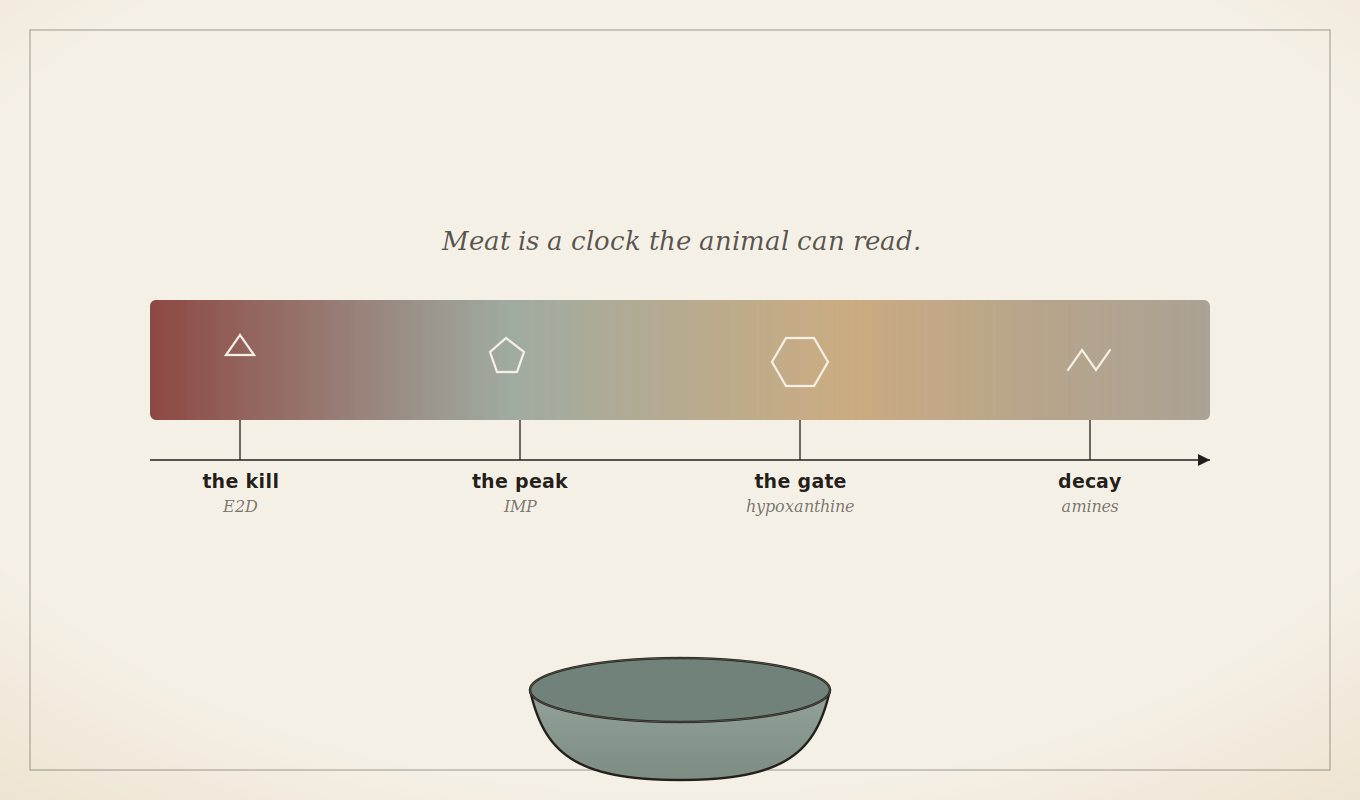
At the instant of death, the muscle is still charged with adenosine triphosphate, ATP, the molecule that powered it in life. With the animal gone and the oxygen with it, that ATP begins to fall apart along a fixed staircase: to ADP, to AMP, and then, within the first day or two, to a compound called inosine monophosphate, IMP. And IMP is not a waste product. It is one of the most powerful savoury molecules in all of food, the nucleotide that carries umami, the very compound the tongue of an obligate carnivore is built to detect. In the first hours after death the meat is quietly filling with the taste of savour. This is the peak. This is freshness at its most delicious, and it is why a signal on the taste side and a signal on the smell side both point, in a fresh kill, to the same conclusion.
But the staircase does not stop at IMP. It keeps descending, only more slowly, because the enzyme that breaks IMP down is the rate-limiting step, and so IMP lingers at its peak for a while, a plateau of deliciousness, before it gives way. When it gives way it becomes inosine, and then hypoxanthine, and hypoxanthine is bitter. The savour fades and a faint bitterness rises in its place. Long before any bacterium has done its work, long before the meat has begun to rot in any sense a nose would recognise, the taste has already started to tell the animal that the best moment has passed.
IMP is the taste of freshness at its peak. Hypoxanthine is the taste of that peak already passing.
This is the taste-side clock, and the tools of fish science measure it directly. The freshness of fish is graded by a number, the K-value, that is simply the ratio of the spent compounds, inosine and hypoxanthine, to the whole family of ATP breakdown products. A low K-value is a fresh fish; a high one is a fish whose clock has run down. A carnivore does not carry a laboratory, but it carries the same reading in its mouth. The E2D of the last conversation was freshness announced at the very first instant, ab initio, off the wound. The nucleotide clock is freshness measured across the hours that follow, the savour rising to a peak and then, molecule by molecule, beginning to leave. Between them, smell and taste, the animal has a remarkably precise clock on how long ago something died.
And this is where one ingredient proves the entire argument of this essay, more plainly than any reasoning could.
Consider liver. Ask anyone who has fed cats and dogs which single ingredient they find hardest to resist, and liver will be near the top of every list. Cats can be so taken with it that they will overeat it against their own interest. On a protein specification, liver is unremarkable, roughly comparable to muscle, sometimes lower. If protein were the thing an animal was chasing, liver would be ordinary. It is not ordinary. It is close to irresistible, and the reason is precisely the vocabulary this essay has been assembling.
Liver is not muscle at rest. It is the body's most metabolically active organ, a chemical factory that never idles in life, and it is therefore dense in exactly the compounds a carnivore is tuned to read: nucleotides in abundance, free amino acids and short peptides, the blood that carries the heme and its metallic note, and the fat that carries so much else. Everything the tongue and nose of a carnivore evolved to prize is concentrated in that one organ, not because it holds more protein, but because organ function itself, the ceaseless traffic of a living liver, leaves its signature in the tissue. The palatability of liver is metabolism made edible.
Liver is not more protein than muscle. It is more of everything the protein was never carrying.
There is a quiet lesson folded inside this for anyone tempted to think the answer is simply to add the missing molecules back. Some of what makes the organ precious does not survive the factory. The heat of processing degrades the very taurine and the B vitamins that made the raw organ so complete for a cat, which is why they must be added back as supplements at all. We are already, without quite admitting it, conceding the point: the raw tissue delivered something that our processing removes and then reconstructs in part. Nutrition we can rebuild. Whether we have rebuilt the whole of what the animal was reading is a different and far less settled question.
WORDS ONLY FIRE CAN SAY
Everything so far has been about what the raw tissue already holds, or makes for itself: the fat woven into the membranes, the peptides carved out by the cell's own enzymes, the nucleotides rising and falling on their clock. But a large part of meat's language does not exist in the raw material at all. It has to be written, and the pen is heat.
Return to the barbecue we started at. The raw chop on the counter is faint, a little metallic, faintly of blood, and almost nothing like the thing that will fill the garden twenty minutes later. What happens in between is chemistry of real complexity, and it has a name. When the amino acids and the reducing sugars in the meat are brought together at temperature, they enter the Maillard reaction, a cascade of hundreds of steps that generates hundreds of new molecules that were simply not present before. Alongside it runs Strecker degradation, breaking amino acids into their own aromatic fragments, and alongside that the breakdown of the lipids, throwing off volatile pieces of the fat. These are not small effects. The characteristic flavour of cooked meat is very largely a creation of these thermal reactions. The roast, the sear, the brown crust: this is a vocabulary spoken only by fire, and the raw tissue is merely the reservoir of words waiting to be said.
Here, at last, is a part of the language where the alternative-protein project is on strong ground, and I want to say so plainly. The Maillard reaction does not, in principle, care where its amino acids and sugars came from. Give it the free amino acids of a fermented biomass and the reducing sugars of a plant, hold them at the right temperature, and it will brown and roast and generate savour on a meat-free substrate as readily as on a muscle. Much of the industry's real success in savoury flavour lives exactly here, in the deliberate use of thermal reactions and the hydrolysates that feed them. If any part of meat's language can be spoken fluently by a plant or a ferment, it is this one.
The Maillard reaction does not ask where its ingredients were born. This is the part of the language a plant can learn to speak.
But notice the boundary, because it is precise, and it takes us straight back to the grill. The Maillard reaction supplies the meaty. It does not, by itself, supply the chicken, or the lamb, or the beef. The generic roasted savour is shared; the species identity rides on the lipid substrate underneath it, on those branched-chain fatty acids and species-specific phospholipids that the heat is acting upon. Cook two different meats and the Maillard chemistry is broadly the same in both; what differs is the fat it has to work with, and the fat is where the animal's name is written. So heat can give a fungal kibble the word for cooked. Whether it can give it the word for a particular prey is a harder question, and it returns us, every time, to the fat.
There is a second, quieter point in this for the formulator, and it connects the two halves of the essay. Some of the most meaty of all the thermal compounds are built, in part, from the very nucleotides we were just discussing. The IMP that carries umami on the tongue is also a precursor that heat can convert into some of the most potent roasted, meaty aromas known. The freshness clock and the fire are not separate systems. The molecule that signals a fresh kill to the taste is the same molecule that, under heat, helps write the smell of the roast. Meat's vocabulary is not a list of independent words. It is a web, in which the same molecule can mean one thing to the raw tongue and another thing entirely once the fire has spoken it.
CONTROLLED SPOILAGE
Follow the clock past its best moment and it does not simply stop. The same self-digestion that filled the fresh meat with savour keeps running, and now a second cast of characters arrives: the bacteria. What they do next is, on the surface, the story of rot. Read more closely, it is one of the most interesting things in this whole essay, for it is also the story of some of the most prized foods we make.
When microbes settle into meat, they set about the free amino acids that self-digestion so helpfully produced, and they strip the acid group from them. This is decarboxylation, and its products are the biogenic amines, each one traceable to the amino acid it came from: histidine becomes histamine, tyrosine becomes tyramine, lysine becomes cadaverine, ornithine becomes putrescine. The names alone tell you which way this is heading. Cadaverine and putrescine are the smell of decay, and their rise is a reliable index that decomposition has begun.
But the story is not as simple as good versus spoiled, and this is the part worth slowing down for. Some of these amines are genuinely aversive, even dangerous: histamine at high levels is the cause of scombroid poisoning, and tyramine and phenylethylamine can push blood pressure and trigger headaches. Some are close to neutral, present at low levels in perfectly healthy tissue as part of the ordinary chemistry of living cells. And some, in the right food at the right concentration, are not spoilage at all. They are flavour. The depth of an aged cheese, the tang of a fermented sausage, the savour of a fish sauce that has stood for a year: these are, in significant part, the taste of the very same amines, produced by the very same decarboxylation, that in another vessel we would have called rot.
Aged cheese and rotting fish share a chemistry. The only difference is who was invited.
Here is the thing that ought to stop a formulator in their tracks. The enzymes that carry out this decarboxylation are found in the microbes of spoilage and in the microbes of fermentation alike. The reaction is the same. The products are the same family. What separates the cheese from the rot is not the chemistry but the control: which organisms were present, at what temperature, for how long, under what salt and what acid. Choose the culture and hold the conditions, and you get the sausage. Let the wild flora arrive on their own terms, and you get the bin.
Fermentation, in other words, is spoilage you chose the microbes for. Rot is spoilage that chose its own.
Fermentation is spoilage you chose the microbes for. Rot is spoilage that chose its own.
I set this at the end of the essay, and not as a flourish, because of where the alternative-protein industry actually stands. A great deal of the most serious work in the field is fermentation: mycoprotein grown in tanks, precision-fermented ingredients, biomass raised by cultures under tight control. The industry is already, and expertly, working the far end of the very freshness gradient this essay has walked. It has spent its skill on the controlled end, on safety and consistency and the avoidance of the aversive amines, which is exactly right and not to be second-guessed.
The question I want to leave in the room is subtler than safety. Meat is not palatable because it sits at one fixed point on this gradient. It is palatable because a carnivore evolved to read the whole of it: the fresh-kill signal at the top, the umami of the peak, the first bitter hint of the turn, and yes, in aged and cured and fermented forms, some of the controlled notes of the descent. If we are learning to build proteins by fermentation, we are already speaking the last dialect on the gradient. The unanswered question is whether we are shaping it only away from what is dangerous, or also toward what an animal would recognise as the deep, aged, savoury language it has always known food to speak.
THE WHOLE ENSEMBLE
Stand back now from the gradient we have walked, and look at the whole of it at once.
At the top is the fresh kill, and the blood-borne molecule a predator reads off the wound in the first instant. Then the savour rising as the nucleotides climb to their peak, the umami of a thing at its freshest. Then the first faint bitterness as that peak begins to pass, the taste telling the animal the clock has started. Beneath all of it, from the very beginning, the fat and its phospholipids, carrying the name of the species in molecules no scale will weigh. Through the middle, the meat quietly digesting itself, cathepsins carving savour out of structure. And at the far end, the controlled descent, the aged and fermented notes that are spoilage tamed and made delicious. This is not a list of ingredients. It is an ensemble, and every part of it is playing at once.
That is the word I have been circling for three of these conversations. Meat is not a substance. It is an ensemble, a whole orchestra of signals sounding together, and a carnivore did not evolve to eat any one of them. It evolved to hear the chord.
And an ensemble is more than the sum of its players. This is the part the specification can never hold, because it is not written in any one component but in the way they sound together: the proportion, the timing, the interference of one note against another. You could fill every chair on the stand, source each molecule on the list and set it in its place, and still not have meat, because meat was never the collection of its parts. It was their playing together. The chord is not the notes.
And this is the thing I most want to leave with anyone rebuilding meat from something that was never an animal. When we replace meat, we do not replace the orchestra. We replace some of the players. We are very good now at the nutrition, which is the section that keeps the animal alive; we are increasingly good at the roasted, Maillard savour, which any substrate can be taught to sound. But the fat that carries the species, the nucleotide clock, the self-made peptides, the deep controlled notes of the aged descent, many of these chairs are still empty, or filled by a player reading from a different score.
Here is the question that keeps me up, and that I do not think the industry has yet asked itself squarely. An incomplete orchestra is not simply a quieter orchestra. Leave out the strings and you do not get the same symphony played softly; you get a different piece, and sometimes a discordant one. The parts that are present, sounding without the parts that are absent, can be worse than silence, because the animal is not comparing our formulation to nothing. It is comparing it to a chord it has known for forty million years. A bowl that delivers perfect nutrition and half the ensemble may not read to a cat as incomplete meat. It may read as something that is trying to be prey and failing, which is a harder thing to forgive than a food that never pretended at all.
I do not say this to discourage the project. I say it because the project is worth doing well, and doing it well means being honest about what is actually on the stand. Nutrition was never going to be the whole score. It was the first section to learn its part. The work now is the rest of the ensemble: to find which of the empty chairs matter most to the animal, and in what combination, and whether the players we do have are sounding in tune with one another or merely sounding.
Perhaps meat was never just an ingredient. It was an orchestra, and the animal at the bowl has been listening to the whole of it all along. The question for the next diet is not whether it can analyse like meat. It is whether, when the animal leans in to listen, the chord rings true.
- Mottram, D.S. (1998). Flavour formation in meat and meat products: a review. Food Chemistry 62(4): 415–424. doi:10.1016/S0308-8146(98)00076-4
- Mottram, D.S. & Edwards, R.A. (1983). The role of triglycerides and phospholipids in the aroma of cooked beef. Journal of the Science of Food and Agriculture 34(5): 517–522.
- Toldrá, F. & Flores, M. (1998). The role of muscle proteases and lipases in flavor development during the processing of dry-cured ham. Critical Reviews in Food Science and Nutrition 38(4): 331–352. doi:10.1080/10408699891274237
- Howgate, P. (2006). A review of the kinetics of degradation of inosine monophosphate in some species of fish during chilled storage. International Journal of Food Science & Technology 41(4): 341–353. The freshness K-value derives from Saito, T., Arai, K. & Matsuyoshi, M. (1959), Bulletin of the Japanese Society of Scientific Fisheries 24: 749–750.
- McGrane, S.J., Gibbs, M., Hernangomez de Alvaro, C., Dunlop, N., Winnig, M., Klebansky, B. & Waller, D. (2023). Umami taste perception and preferences of the domestic cat (Felis catus), an obligate carnivore. Chemical Senses 48: bjad026. doi:10.1093/chemse/bjad026
- Gassenmeier, K. & Schieberle, P. (1994). Formation of the intense flavour compound trans-4,5-epoxy-(E)-2-decenal in thermally treated fats. Journal of the American Oil Chemists’ Society 71(12): 1315–1319. doi:10.1007/BF02541347
- Watson, P.E., Thomas, D.G., Bermingham, E.N., et al. (2023). Drivers of palatability for cats and dogs: what it means for pet food development. Animals 13(7): 1134. doi:10.3390/ani13071134
- Prester, L. and the Frontiers review of biogenic amines in seafood (2012), Frontiers in Microbiology 3: 188, doi:10.3389/fmicb.2012.00188; on fermentation as controlled decarboxylation, see the review of biogenic amines in fermented foods (2024), Heliyon, doi:10.1016/j.heliyon.2024.e25553.
Dr. rer. nat. habil. Dr. Seronei Chelulei Cheison is the founder and Chief Executive Officer of Sinonin Biotech GmbH, a biotechnology company focused on alternative protein and palatability enhancer innovation and application for petfood formulations. He formerly led alternative protein and palatant development projects at the Mars Petcare Global Innovation Centre in Verden, and spent close to two decades in academic research on enzymatic protein hydrolysis, holding a doctorate from Jiangnan University and a habilitation from the Technical University of Munich.
Sinonin Biotech GmbH is a partner in two consortia funded under the Circular Bio-based Europe Joint Undertaking: ZEST, on fungal fermentation of agricultural residues, and PROSCALE, on scalable microbial protein ingredients, which runs from September 2026 to August 2030.
Co-funded by the European Union under Grant Agreement No. 101157382 (ZEST) and Grant Agreement No. 101288362 (PROSCALE). Views and opinions expressed are however those of the author only and do not necessarily reflect those of the European Union or CBE JU. Neither the European Union nor the CBE JU can be held responsible for them.
