
Petfood Palatability: Why Fat Is the Signal Alternative Proteins Forget
Oiling the Palatability Wheel
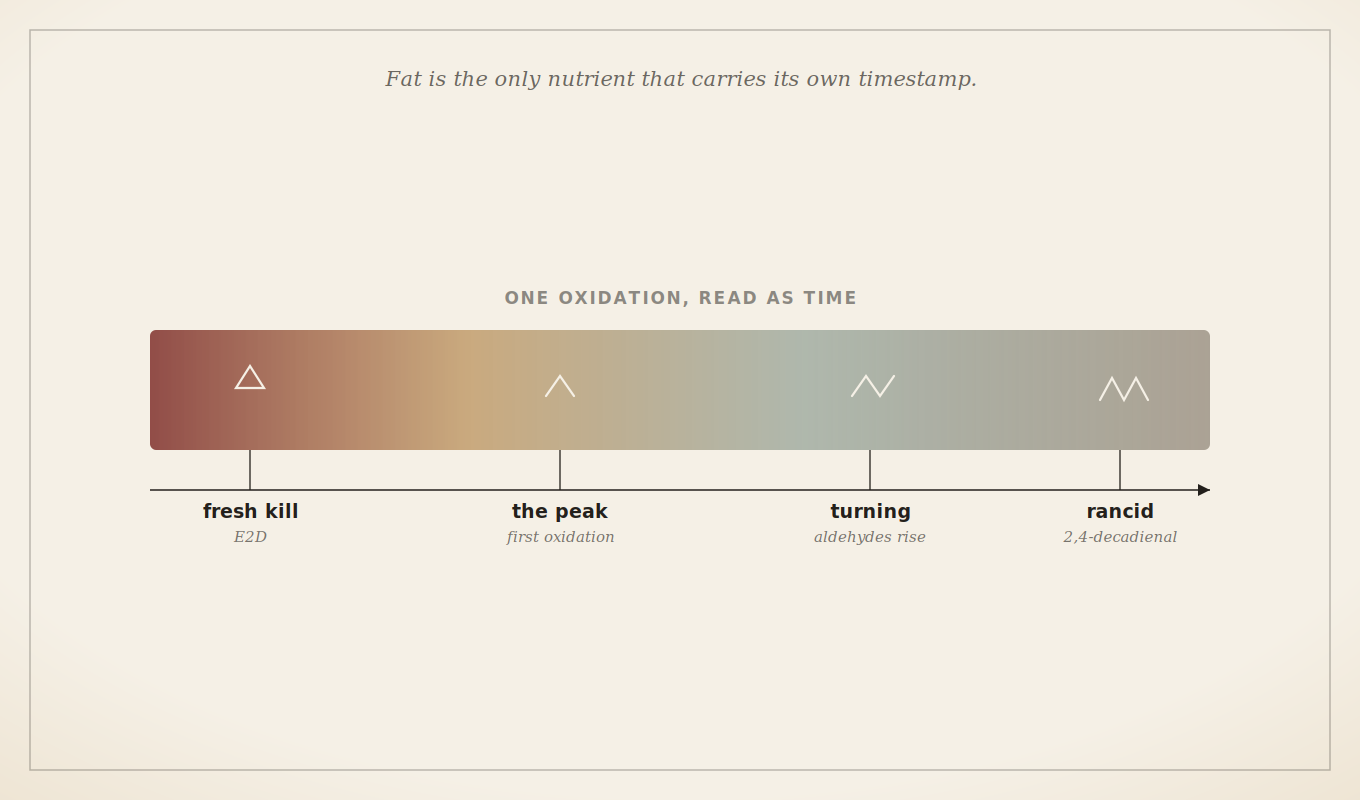
Fat is the only nutrient that carries its own timestamp. The animal at the bowl has been reading that clock all along.
Open a fresh bottle of fish oil and smell it. Close it, leave it on the shelf, and open it again a week later. The two smells are not the same, and you do not need a laboratory to know it. The nose reports the change instantly, with a certainty that feels almost like alarm. Something has happened.
Here is the strange part. In that week, very little has changed that a nutrient panel would notice. The energy is the same. The fatty acids are, to a first approximation, the same. The degradation that will eventually matter to the body, the slow loss of the delicate omega-3s, has barely begun; the nose sounds its warning long before the nutrition is meaningfully harmed. By every measure a specification sheet cares about, the oil is still the oil. And yet you know, before you have thought about it, that you would not now put a spoon of it in your mouth.
We have a word for what the nose is reporting. We call it rancidity. But what, exactly, are we smelling? Not a loss of nutrition, which has scarcely occurred. Not a change we can see. We are smelling time. The fat has kept a record of how long it has sat, written in molecules too faint to matter to the body and too loud to miss with the nose, and the animal reading that record is doing something a spec sheet cannot do at all. It is telling the hour.
This is the thing about fat that the protein age has almost entirely overlooked. Protein feeds. Carbohydrate feeds. Fat feeds too, and richly. But fat also does something none of the others do: it keeps time. Leave a protein on the shelf and it ages quietly, in ways the nose can barely detect. Leave a fat, and it begins, from the first day, to tell you how long it has been left. Fat is the only nutrient that carries its own timestamp, and every creature that ever hunted learned to read it, because the difference between a fresh kill and a spoiled one was, quite literally, the difference between a meal and a poisoning.
I have spent three of these Friday conversations on what an animal wants to smell and taste in its food: the second on a signal read off a fresh wound, the third on the many voices of meat that are not its protein. This fourth one is about the nutrient that sits underneath all of that, carrying more of the signal than we credit and almost none of the credit it carries. It is about fat, and about a question the alternative-protein transition has been slow to ask out loud. We have learned, impressively, to rebuild the protein. Have we understood the fat well enough to tell the animal it is fresh, and not, a week later on the shelf, exactly the opposite?
The Alternative Protein Conversation That Forgot The Fat
Let me be fair to the transition before I press on it, because it has earned the fairness. The work of the last two decades has been, overwhelmingly, protein work, and that was the right place to start. An obligate carnivore needs a great deal of protein, of a particular quality, and building that from plants and fungi and single cells is genuinely hard. The industry has largely solved it. There are complete amino acid profiles, adequate digestibility, the taurine and arginine supplemented where the chemistry falls short. Nobody should wave that away.
But notice what the whole conversation has been organised around. There are protein action plans and protein transitions and protein start-ups. There is no fat transition. Fat has been treated as the easy part, the thing you add back at the end once the hard protein problem is solved, a commodity you buy by the drum and pour on. And this is precisely backward, because a large part of what makes food palatable to a carnivore was never the protein at all. It was the fat.
Consider what the animals themselves choose when you let them. Give a cat the freedom to compose its own diet from separate sources and it settles, with real consistency, on a balance of roughly 52% of its energy from protein, 36% from fat, and 12% from carbohydrate. Give a dog the same freedom and it lands somewhere quite different: around 30% protein and 63% fat, reaching for nearly twice the fat the cat takes. The dog forgives the fat; the cat audits it. These are not idle preferences. The animal defends them, and will override an unpromising flavour to hit its target. There is an old piece of folklore in the trade about some magic ratio of protein to fat that unlocks palatability, and the folklore has it not quite right. What the numbers actually show is two different things braided together: a nutritional target the animal is trying to reach, and a palatability response to what is in front of it. The ratio is real. It is just not the whole of the story, and mistaking the one for the other has cost the field more than it knows.
The dog forgives the fat. The cat audits it.
And here the numbers open onto something genuinely unsettled, which is worth pausing over rather than rushing past. The cat that self-selects 36% of its energy from fat evolved eating prey that delivers closer to 46%. On protein the match is almost exact; on fat the animal we observe in the feeding trial settles well below what its wild prey would have given it, and on carbohydrate it drifts to six times what prey ever supplied. So which is the true target, the profile the cat reaches for on our diets, or the profile its prey actually carried? When whole prey itself ranges from a tenth to well over half fat depending on the season and the animal, is the cat defending a number at all, or a range? How much of what we record as preference is simply what the bowl allowed the animal to reach? I raise these not to answer them, because I cannot, but because a field confident enough to engineer a diet ought to be honest about how loosely we understand the target it is engineering toward.
There is one more thing the protein framing misses, and it is the largest. When we say fat matters to palatability, we tend to mean taste and richness, the mouthfeel of it. That is real, but it undersells the case badly. Fat’s deepest contribution is to aroma, and aroma is the sense that leads. The nose reaches the food before the mouth does; it forms the first judgement, the go or no-go, before a single taste receptor has fired. And aroma lives in fat. The volatile molecules that carry the smell of food are mostly fat-soluble; they dissolve into the fat, are held by it, and are released from it as it warms. Fat is not merely one contributor to flavour among several. It is the reservoir the aromas are kept in, the medium they travel by, and, as we will see, the very material from which many of them are made. Forget the fat and you have not forgotten a garnish. You have forgotten the thing the animal smells first.
One Fatty Acid, Two Messages
To see how fat carries a signal, and how the same fat can carry its opposite, we have to follow a single fatty acid on the one journey that matters: oxidation. It is the reaction at the centre of this entire essay, and its most important feature is that it is not an event but a road. A fat does not simply oxidise or fail to. It oxidises progressively, passing through stages, and where it happens to be along that road is precisely what the animal’s nose is reading.
Take linoleic acid, the polyunsaturated fatty acid that sits in most of the fats we care about. Early on the oxidation road, when the reaction has only just begun, it throws off a particular set of light, volatile fragments, and among them is a molecule I have written about before: the compound that signals a fresh kill, the one a carnivore reads off a wound before it has taken a bite. Freshly begun oxidation smells, to the animal built to read it, like something recently and cleanly dead. This is the attractant, and it appears at the very top of the road.
Keep going down the same road, though, and the same linoleic acid tells a different story. The light early fragments give way to heavier ones, the secondary aldehydes with names like hexanal and 2,4-decadienal, and these are the smell we call rancid: painty, cardboard, stale, wrong. Nothing new was added. No different fat arrived. The identical molecule that produced the fresh signal at the start of its oxidation produces the spoiled signal further along, because oxidation simply kept running. The precursor of the attractant is the precursor of the repellent. They are the same fat, one stretch of road apart.
The molecule that says fresh kill and the molecule that says rancid are the same fat, one step apart.
This is worth holding still for a moment, because it resolves something that might otherwise look like a contradiction across these essays. If the fresh-kill molecule is itself a product of oxidation, and rancidity is also a product of oxidation, how can the animal prize the one and refuse the other? The answer is that it is not reading oxidation as a yes or a no. It is reading how far the oxidation has gone. Fresh oxidation, the first tick, says eat now. Advanced oxidation, many ticks later, says too late. The animal is not asking whether the fat has oxidised. It is asking what time it is.
Now bring a real oil into it, because this is where the abstraction earns its keep. Sunflower oil is a useful case, and a slightly awkward one for anyone who assumes plant fat is simply inferior fat. In a controlled trial where the only thing that changed was the fat coating a kibble, dogs preferred sunflower oil over poultry fat and over beef tallow, and the researchers attributed the preference to sunflower’s high content of linoleic acid. Read quickly, that looks like a straightforward win for the plant oil. Read slowly, it is the whole dilemma of this essay in one result. The very thing that made the sunflower oil attractive, its richness in linoleic acid, is the very thing that makes it spoil fastest, because linoleic acid is precisely the polyunsaturated fatty acid that runs down the oxidation road quickest. The oil is preferred because it is rich in the precursor of the fresh signal. It is fragile for exactly the same reason.
The plant breeders, it turns out, have already been fighting this war, and it is worth knowing which side they chose. Conventional sunflower oil is high in linoleic acid, which makes it flavourful and makes it perishable. To improve its shelf life, breeders have spent decades selecting for a high-oleic sunflower instead, trading the polyunsaturated linoleic away for the far more stable monounsaturated oleic. The newer oil keeps for longer on the shelf. But look at what was given up to get there: the linoleic acid that was bred out is the very fatty acid the dogs were responding to, and the precursor of the fresh signal itself. The industry, chasing stability, has been quietly breeding out the molecule of freshness. You may have stability or you may have the signal, and the same acid governs both. There is no variety that gives you both at once, and anyone who tells you a single sunflower oil is both maximally palatable and maximally stable is describing two different oils and hoping you will not notice.
There is a deeper convergence hiding in all of this, and it reaches back to the fire of the last conversation. The fresh-kill molecule is not only born cold, at the wound. It is also born hot, in the pan. When animal fat is heated, its polyunsaturated fatty acids, the linoleic and the arachidonic, break down under the heat and generate the very same molecule, by a different route. The wound writes it at body temperature in seconds; the fire writes it again from the fat at cooking heat. One signal, two origins, and both of them lipid. It matters, too, that this is not the browning reaction people usually credit for meaty smell. The roasted, savoury notes that any protein can be coaxed into giving off under heat are a separate chemistry, and I gave them their due last time. This is not that. This is thermal oxidation of the fat itself, and it is fussier about its raw material: it needs the right polyunsaturated fatty acids, the ones animal fat carries in species-specific proportion, poultry fat notably rich in linoleic, pork fat carrying appreciable arachidonic. The browning any substrate can fake. The fresh-kill note it cannot, because that one is written in the fat, and the fat has to be the right fat.
The Lipid Freshness Clock
In the last conversation I described a clock the tongue can read, the slow slide of the meat’s own nucleotides from the savour of freshness toward the bitterness of age. Fat keeps a second clock, and it runs on the nose. The two are worth setting side by side, because between them they explain how an animal with no calendar and no thermometer knows, with such speed and such conviction, how long ago its food was alive.
The lipid clock is the oxidation road we have just walked, read as time. At the first tick, the fresh-kill molecule, cleanly begun oxidation, the smell of something recently dead. Later ticks, the accumulating aldehydes, the smell of something left too long. The fat is not merely spoiling or not spoiling. It is advancing, steadily, along a track the animal has evolved to read as a position in time. This is why I keep returning to the word clock rather than the word freshness, because freshness sounds like a single quality a thing either has or lacks, and that is not what the animal is reading. It is reading a moving hand. Fat does not just feed the animal. It tells the animal the time.
I want to slow down here and be careful, because there is a question folded into this that the science has not actually settled, and it would be easy to skate over it with a confident sentence. When the nose reports that a fat has turned, what is it really reading? Is freshness the same thing as oxidation, simply the chemical fact of it, measurable in a laboratory? Or is freshness something the animal makes of that chemistry, an interpretation laid over the measurement, the difference between what a molecule is and what it means to the creature smelling it? I do not think these are the same question, and I do not think we know the answer to the second one. We can measure the oxidation precisely. What the animal does with that measurement, whether it reads a number or a meaning, is a genuinely open matter, and I would rather leave it open and honest than closed and wrong.
Let me put a human face on it, because I have one, and because it makes a point no diagram can. I grew up in Nandi County, in the Kenyan highlands, and like children across much of the world in those years we were dosed, at the first sign of a cold, with a spoonful of Scott’s Emulsion. It came in a bottle bearing a picture that has never left me: a man striding along with an enormous fish slung across his back, cod liver oil rendered into a thick, sweetened emulsion. The taste was an ordeal. The smell was worse. I am fairly sure some of us recovered from our colds through sheer dread of the next spoonful, willing ourselves well to escape it.
Here is why that memory belongs in an essay about fat. That smell was appalling, and the oil was not spoiled. Cod liver oil smells like that fresh from the factory; the whole elaborate business of the emulsion, the lime and the sugar and the glycerine, was an attempt to bully a wholesome, intensely fishy oil into something a child would swallow. The smell was not the smell of rot. It was the smell of what the oil simply is. And that is the trap at the heart of the freshness question, the thing the nose gets wrong as easily as it gets right: a strong smell does not always mean a spoiled one. Intensity and spoilage are two different axes, and a nose can confuse them. The child gagging on Scott’s Emulsion was reading a strong smell as a bad one, and was, on the evidence of a century of dosed and recovered children, mistaken. Which ought to make us wonder what the cat is really doing when it turns from a fat we have called rancid. Is it reading spoilage, or only reading strength? Is it refusing something dangerous, or something merely loud?
Rotten, Or Merely Not Fresh?
That question, the one the child on the spoon could not answer, turns out to be the question the whole industry cannot answer either, and a great deal rides on it. When a cat turns from a fat we have judged rancid, what is it actually reading?
Begin with a distinction the trade tends to blur. Rancidity and rot are not the same chemistry. Rancidity is oxidation, the fat reacting with air, throwing off the aldehydes we have been tracking. Rot is decay, the work of microbes breaking tissue down into a different family of molecules entirely, the amines I described in the meat of the last conversation. A rancid fat and a rotting carcass smell wrong in different ways, by different routes, because different things are happening in them. So when a cat refuses an oxidised fat, it cannot literally be reading rot, because the molecules of rot are not there. It is reading something else. But what?
There are, as far as I can see, three honest possibilities, and I want to lay them out without pretending to know which is true. The first is that the cat is making a mistake in its favour, reading advanced oxidation as though it were the beginning of decay, treating the rancid fat as a proxy for a rotting one and refusing it out of an abundance of evolved caution. On this reading the refusal is a false alarm, a safety reflex firing at the wrong trigger, and the cat is being fooled by a resemblance. The second possibility is that the cat is reading exactly what is there and nothing more: not danger, but lateness. Not this will harm me, but this is no longer fresh. On this reading the cat is simply far along the lipid clock, registering a position in time and declining a fat that has moved too far down the road, the way you might decline bread that has gone stale without for a moment thinking it would poison you. And the third possibility is that oxidation is its own signal to the carnivore, neither borrowed from the alarm of rot nor merely a reading of freshness, but a distinct thing the animal evolved to weigh in its own right, for reasons we have not yet worked out.
I do not know which of these is correct, and I am not sure anyone does. But notice that the difference between them is not academic in the least, because it decides whether the problem in front of a formulator is a wall or a workbench. If the cat is reading rancidity as danger, as rot, then the refusal is a hard biological veto, wired deep, and no amount of clever chemistry will talk the animal out of it; you would be fighting an alarm evolution spent millions of years making difficult to silence. But if the cat is only reading lateness, only registering a position on the freshness clock, then the problem is not a veto at all. It is a matter of kinetics. It becomes a question of how fast the oxidation runs and how far it has gone by the time the bowl is filled, and those are things a formulator can actually govern, with antioxidants, with packaging, with the freshness of the fat going in, with how long the food sits between the factory and the animal. A wall is a fact you must design around. A workbench is a problem you can work at. And we do not yet know which one rancid fat is, which means we do not yet know whether the single largest sensory obstacle to feeding a carnivore on stable, shelf-friendly fats is insurmountable or merely unsolved. That strikes me as a thing worth finding out before we build much more of the future on a guess.
A wall is a fact you must design around. A workbench is a problem you can work at.
The Machine That Could Not Marble
There is a reason the fat got left until last, and it is not that anyone forgot it. It is that the machine at the centre of the whole enterprise cannot handle much of it. Once you see this, the flat sensory experience of so many meat analogues stops looking like an oversight and starts looking like a consequence.
The plant-based whole cut is built, overwhelmingly, by extrusion. Protein and water are driven through a twin-screw barrel under heat and pressure, and the shear inside tears and realigns the protein into fibres that pull apart on the tongue like muscle. It is a genuinely clever process. It is also, by its own physics, at war with fat. An extruder works by friction: the screws grip the protein mass and drive mechanical energy into it, and that energy is what builds the structure. Fat does the opposite of grip. It lubricates. Add much of it and the screws begin to slip, the energy stops transferring, the fibres fail to form, and the oil weeps out onto the surface. So the machine has a ceiling, and the ceiling is low. Texturised proteins are typically run at something like 0.5 to 6% fat. The meats they are built to imitate carry 20, 40, 60%. The core technology of the industry can hold only a fraction of the fat of the thing it is trying to become.
So the fat is banished to the end of the line. It is sprayed on afterward, cold, onto the finished fibre, as a coating. And this is the quiet defeat beneath so much of the category, because coating fat is raw fat. It has passed through none of the chemistry that turns fat into flavour. It never met the heat that would have generated the fresh-kill note from its precursors; it never oxidised even to the first fresh tick of the clock. It sits on the surface, greasy and mute, doing almost none of the work fat does inside an animal. The problem was never that these foods contain too little fat. It is that the fat is in the wrong place, added too late, in the wrong state, contributing mass and lubrication and nearly nothing to the nose.
Set that against the animal the whole project is chasing. A Wagyu breeder spends the better part of a decade coaxing fat to deposit not around the muscle but woven through it, marbled into the tissue in fine seams, and the world pays extraordinary sums for the result. What is being paid for is not protein; Wagyu’s protein is ordinary beef protein. It is the fat, and specifically the architecture of the fat, its distribution, its low melting point, the way its intramuscular seams liquefy on the tongue at body heat and carry flavour as they go. The animal builds its lean and its fat together, in the same tissue, on the same day, by the same body. That is the standard. And the extruder, for all its ingenuity, cannot approach it, because the extruder cannot marble. It can only paint.
The extruder cannot marble. It can only paint.
Let The Reactors Converge
And yet I do not want to end on a defeat, because the ground is shifting under this problem faster than almost anywhere else in the field, and for the first time the fat is being taken seriously on its own terms. A generation of companies has stopped treating fat as the easy part. Some are growing true fat cells in bioreactors. Some are brewing tailored fats by fermentation, coaxing yeasts and other microbes into producing the specific molecules they want. Some are structuring plant oils to behave, at last, like the marbled fat of an animal rather than a puddle at the bottom of the pan. The framing has finally caught up with the biology. The taste gap, these companies now say plainly, was a fat gap all along.
But I want to press one request on that emerging field, because it is the whole argument of this essay folded into a single ask, and the field is at exactly the moment when the ask can still shape it. It is not enough to solve the muscle in one reactor and the fat in another and marry them at the end. That is how we arrived at the painted extrudate in the first place, only more expensively. An animal does not grow its lean in one place and its fat in another and glue them together before serving. It marbles them, fibre and fat laid down together, in the same tissue, by the same body, on the same day. The hardest and least-solved problem in the whole endeavour is precisely this, the growing of muscle and fat as one marbled structure rather than two ingredients kept apart, and it is the problem most worth solving, because it is the one that separates alternative tissue from alternative meat.
So let the reactors converge. Let the fat and the muscle be grown into one scaffold, marbled from the start, so that what emerges is not lean here and grease there but a single thing an animal would recognise and a mouth would too. That is the difference between building alternative tissue in one place and alternative fat a continent apart, and building, at last, animal-free fatty meat. Alternative meat, in other words, and not merely its parts.
Marbling puts the fat in the right place. It does not make the fat say anything, not even about the species.
But I have to press the point one turn further, because marbling alone is a trap, and it is the very trap this whole essay has been circling. Put the fat in exactly the right place, woven through the muscle in perfect seams, and you may still have built something that says nothing. Structure is not signal. A cut can be flawlessly marbled and aromatically mute, fat in all the right seams and not a word of fresh kill in any of them. If we design only for where the fat sits and not for what the fat carries, we will grow beautiful lipo-bodies: sculptures of fat in the shape of meat, correct in every architecture and silent in the one language the animal is actually listening for, unable, for all their perfect marbling, to say even which animal they are pretending to be.
So the harder design brief, the one that separates a serious attempt from an expensive imitation, is not structural at all. It is chemical. It is to build fat that can still speak: fat that carries the right polyunsaturated precursors, that can run the freshness clock, that will generate the fresh-kill note under heat and read as recently and cleanly dead to the nose evolved to judge it. That is a far deeper problem than positioning a fat correctly, and we have barely begun to pose it, let alone solve it. But it is the problem that matters, because the animal was never grading the marbling. It was reading the smell.
And here is the test, the one I opened a previous conversation with and can now hand back to you sharpened. Stand in front of a barbecue with your eyes closed. You knew, then, what was cooking, because the fat was speaking, each species in its own aromatic dialect, written by the oxidation of its own particular fats under the heat. Now imagine the cultured cut on those same coals. If it marbles like meat and browns like meat and still, with your eyes closed, tells you nothing, then we have not made meat. We have made a lipo-body doing an impression of one. The bowl, and the nose above it, will know the difference long before the spec sheet does.
The transition toward alternative proteins has taught us something genuinely large: that nutrition can be redesigned, taken apart and rebuilt from new materials, and made to nourish an animal as well as the old materials did. That is no small thing, and I do not mean to diminish it. But fat reminds us of something the protein triumph can obscure, which is that biology still keeps the time. Every day a fat sits on a shelf moves the hand of that clock a little further, from the fresh note the animal leans toward to the spoiled one it turns from, and the animal reads that clock whether or not we have thought to consult it. The question is no longer only whether we can understand fat well enough to rebuild it. It is whether we understand what the animal reads when it looks at the time.
- Hewson-Hughes, A.K., et al. (2011). Geometric analysis of macronutrient selection in the adult domestic cat, Felis catus. Journal of Experimental Biology 214(6): 1039–1051. doi:10.1242/jeb.049429
- Hewson-Hughes, A.K., et al. (2013). Geometric analysis of macronutrient selection in breeds of the domestic dog, Canis lupus familiaris. Behavioral Ecology 24(1): 293–304.
- Plantinga, E.A., Bosch, G. & Hendriks, W.H. (2011). Estimation of the dietary nutrient profile of free-roaming feral cats. British Journal of Nutrition 106: S35–S48.
- İnal, F., Alataş, M.S., Kahraman, O., İnal, Ş. & Uludağ, M. (2020). Determination of fat preferences of adult dogs. Turkish Journal of Veterinary & Animal Sciences 44(3): 481–486. doi:10.3906/vet-1906-56
- Gassenmeier, K. & Schieberle, P. (1994). Formation of the intense flavour compound trans-4,5-epoxy-(E)-2-decenal in thermally treated fats. Journal of the American Oil Chemists’ Society 71(12): 1315–1319. doi:10.1007/BF02541347
- Marchioni, G. / Kemin. Impact of ingredients’ freshness, including free fatty acids and the oxidation aldehydes hexanal and 2,4-decadienal, on cat and dog dry pet food palatability.
- AFB International. Fat Quality: Impact of Fats on Palatability (technical bulletin), on free fatty acids, peroxide value and hexanal as indicators of rancidity in petfood fats.
- On lipid-derived aroma: role of lipids in food flavour generation, and the oxidation of unsaturated fatty acids to odour-active aldehydes (reviews in Food Chemistry and related literature).
- On high-oleic sunflower stability: comparative oxidative and thermal stability of high-oleic (~5.5% linoleic) versus conventional (~71.6% linoleic) sunflower oils.
Dr. rer. nat. habil. Dr. Seronei Chelulei Cheison is the founder and Chief Executive Officer of Sinonin Biotech GmbH, a biotechnology company focused on alternative protein and palatability enhancer innovation and application for petfood formulations. He formerly led alternative protein and palatant development projects at the Mars Petcare Global Innovation Centre in Verden, and spent close to two decades in academic research on enzymatic protein hydrolysis, holding a doctorate from Jiangnan University and a habilitation from the Technical University of Munich.
Sinonin Biotech GmbH is a partner in two consortia funded under the Circular Bio-based Europe Joint Undertaking: ZEST, on fungal fermentation of agricultural residues, and PROSCALE, on scalable microbial protein ingredients, which runs from September 2026 to August 2030.
Co-funded by the European Union under Grant Agreement No. 101157382 (ZEST) and Grant Agreement No. 101288362 (PROSCALE). Views and opinions expressed are however those of the author only and do not necessarily reflect those of the European Union or CBE JU. Neither the European Union nor the CBE JU can be held responsible for them.
