
20 Aug, 2026

Petfood Palatability and the Plasma That Binds Wet Food

THE FRIDAY CONVERSATION · No. 5

The Glue That Holds the Chunk

Palatability is not only texture. It is also taste and aroma. And in a wet food, the texture is the quiet work of a protein most people have never heard of.

Illustration of a plasma protein network holding droplets of water and fat

The glue, seen close: plasma proteins form a heat-set network that traps water and fat, giving the chunk its juiciness, cohesion, and bite.

Picture a sausage. Season it however you like. Get the smoke right, the pepper, the note of marjoram that makes a good bratwurst smell like a good bratwurst. Now imagine you have matched the aroma and the taste of the real thing so closely that with your eyes closed you could not tell the difference. And then you bite it, and it is wrong. It gives way like wet cardboard, or it is dry and mealy, or it snaps with a brittle, papery crack instead of yielding. The flavour was right. It is still not a sausage.

Anyone who has eaten a plant-based sausage knows this moment. We have, many of us, solved the flavour. What we have not solved is the bite: the springy resistance, the succulent give, the way a real sausage releases its fat and moisture as the teeth dig in.

I raise the sausage because it makes a point both sides of the pet food conversation keep sliding past, and for opposite reasons. Those of us working on alternative proteins struggle to build the texture, and talk instead about flavour, which we can win. The conventional, meat-based makers rarely think about texture at all, because something has always quietly supplied it for them. Both camps are fixated on taste and aroma. Both are sliding past the bite, and I include my own side of the field in that.

Both camps are fixated on taste and aroma. Both are sliding past the bite.

And a sausage is the right way to see this, because a sausage is something we all already know. Very few people outside the industry have ever held the idea of a pet food chunk in their mind, or wondered what makes one hold together and another crumble. But everyone has bitten into something that got the flavour right and the texture wrong. Hold that disappointment in mind and the chunk in a can of cat food stops being an abstraction. It is doing, for a fussier eater, exactly what the sausage does. It has to feel right, not only taste right.

Now, the reason a good sausage feels right is worth pausing on, because it is not one reason but three, and the difference between them is the whole of this conversation. A traditional Nürnberger bratwurst holds itself together. Salt draws the myofibrillar proteins out of the pork, myosin chief among them, the mixing works them into something sticky, and on the grill they set into the springy bite the sausage is prized for. This is the binding quality of the meat itself, the capacity of good muscle protein to become its own structure, and it needs no added glue. The meat is its own glue. A reformed or emulsion sausage, a frankfurter, a restructured cut, cannot rely on that, because the muscle has been comminuted past the point of binding itself, so a binder is added to do the holding. And a plant-based sausage has no muscle proteins to draw on at all, so it must borrow a glue from somewhere else, from soy or wheat gluten or a hydrocolloid, and this is the one that most often fails the bite.

A wet pet food chunk lives, almost always, in the second and third of those worlds, not the first. It is a formed thing, not a slice off an intact muscle, so it needs a binder. And in the animal-based chunk, the binder that has quietly done this job for decades, in millions of cans, is a protein almost no one outside the industry has heard of. It is what holds the chunk together. It is, in the most literal sense, the glue. The question this conversation is about is what happens to palatability, texture included, when we try to take it out.


Movement I

THE PROTEIN THAT HOLDS THE CHUNK

The protein is blood plasma. When an animal is slaughtered, its blood is collected, and the blood separates into two parts: the red cellular fraction, and a pale straw-coloured liquid that is the plasma, a little over half the blood by volume. Spray-dried into a fine powder, that plasma becomes one of the quiet workhorses of the wet pet food industry, and of a good deal of the human meat industry besides. It is not an exotic ingredient. It is in frankfurters, in restructured and reformed meats, in the products where pieces must be made to hold together that were not held together to begin with. It does there exactly what it does in the pet food: it binds.

What makes plasma able to do this is a property worth stating precisely, because it is the whole reason plant proteins struggle to replace it. Plasma is a heat-set gelling protein. Warm it past a certain point and its proteins unfold and lock into a network, a gel, and once set that gel does not melt again on further heating. This is the opposite of gelatine, which sets as it cools and melts as it warms. It matters enormously here, because a chunk in gravy is made by retorting, cooking the sealed can or pouch at a temperature well above boiling, and it is made while sitting in the water of the sauce. A cold-setting protein would dissolve into that hot water and be gone. Plasma sets because of the heat, not in spite of it, and it holds its shape submerged in excess water at temperatures that would melt a lesser binder into broth. That is why the chunk survives the retort.

But binding, in the sense of simply holding together, undersells what plasma is doing, and this is where the texture returns to the argument. Plasma does not only glue the chunk into one piece. It holds water inside the matrix, and it holds fat inside the matrix, so that when the animal bites, the chunk is succulent rather than dry, and it releases moisture and fat the way a real piece of meat would. It gives the chunk resistance and spring rather than mush or crumble. And it stops the chunk from shedding, from breaking down under handling and processing into the cloud of fine particles the trade calls fines, which turn a can of distinct chunks into a slurry. Every one of these is a texture property, and texture, as the sausage told us, is palatability. Plasma is not a nutritional additive that happens to bind. It is a palatability ingredient whose main instrument is texture.

None of this is a matter of my opinion or my palate. It is measurable, and it has been measured. The gel strength of plasma, the temperature at which it sets, its water-holding and fat-holding capacities, the force required to rupture a chunk, all of these are rheology, the physics of how a material deforms and flows and resists, and they can be put on an instrument and read off as numbers. When I say a plasma chunk is springy and succulent and resistant to fines, I am not reaching for adjectives. I am describing behaviour that shows up on a texture analyser, in gel-strength curves, in water-holding percentages. The animal reads these properties with its mouth. We can read them with a rheometer and a texture analyser. They are the same properties.

The animal reads these properties with its mouth. We read them with a rheometer.


Movement II

FROM THE KILL FLOOR TO THE POWDER

It is worth knowing where this ingredient comes from, because the answer is more ordinary and more clever than most people expect. When an animal is slaughtered for meat, its blood is collected rather than discarded, drawn off cleanly while the carcass is still intact so that it stays uncontaminated. That blood is centrifuged, which separates it into the heavier red cell fraction and the lighter, straw-coloured plasma. The plasma is chilled, concentrated, and then sprayed as a fine mist into a tower of hot air, where the water flashes off in seconds and what falls to the bottom is a pale, cream-coloured powder. Spray-dried plasma is roughly three-quarters protein, with a little fat and a notable load of minerals from the salts of the blood and the anticoagulant added at collection. The gentleness matters as much as the process: dry it too harshly and you denature the very proteins whose folding does all the work, so the drying is tuned to preserve function, not merely to remove water. What arrives at the pet food plant is a bag of beige powder that reconstitutes, when it is heated in a chunk, into the clotting, gelling, water-holding structure it had in the living animal.

This is, in the most literal sense, a way of making food out of what would otherwise be waste. The blood that once ran down slaughterhouse drains is now recovered, dried, and sold as a functional protein, which is the kind of circularity the rest of the food system is only beginning to reach for. It is worth holding that in mind through everything that follows, because it complicates the story. The ingredient some of us want to remove is also one of the more genuinely sustainable things in the box.

The ingredient we want to remove is also one of the most sustainable things in the box.


HOW MUCH, AND FROM WHOM

Plasma is not a niche curiosity. The market for animal plasma as a feed and food ingredient runs, by the estimates of the various market analyses, somewhere in the low single-digit billions of dollars a year, and it is growing steadily. But the shape of that market holds a surprise for anyone who assumes this is mainly a pet food story. It is not. The largest single use of animal plasma by far is in feed for young pigs, where its immune and gut-health benefits help weaned piglets through the most fragile weeks of their lives. Aquaculture takes a large share too. Pet food, the application this whole essay is concerned with, is a real but minority slice of the total, something on the order of a sixth of it. The glue that holds the chunk is, in volume terms, a sideline of an ingredient whose main career is elsewhere.

The chunk is plasma’s sideline. Its main career is elsewhere.

The blood itself comes chiefly from pigs and cattle, in roughly comparable amounts, with poultry a smaller and more specialised source, and the industry is built on that split. The trade runs from large international processors, names such as Sonac and Darling Ingredients and the Lauridsen group, down through regional producers such as Badenhop in Lower Saxony, each collecting blood from the slaughterhouses in its reach and drying it close to source, because blood does not travel well before it is stabilised. It is a quietly global business resting on an intensely local raw material, which is one more reason the ingredient is harder to think about replacing than it first appears. To remove plasma from a recipe is not only to solve a problem of chemistry. It is to step out of a supply chain that already exists, that is already circular, and that is already, by the standards of the industry, cheap.


Movement III

AND THEN THE HARDER QUESTION

So far I have kept to the ground I can defend without flinching, because the texture case is settled. Plasma builds the structure of the chunk, and structure is palatability, and all of it is measurable. If the argument stopped there it would already be enough to make removing plasma a real problem rather than a trivial one. But there is a second claim often made for plasma, quieter and much less settled, and honesty requires me to walk onto the shakier ground and say plainly where it gives way.

The second claim is that plasma contributes not only to texture but to taste and aroma. That it is not merely the glue but also, in some measure, a flavour. And here the certainty I had a moment ago deserts me, because the evidence is genuinely divided, and I would rather show you the division than paper over it.

The case for is not nothing. Remember what plasma actually is: the fluid that remains once the cells of the blood are taken away. It is not a single protein but a cocktail of them, albumin and the globulins and fibrinogen, and dissolved among them is everything the blood was carrying that did not leave with the cells. Plasma is the body’s transport medium, and transport is exactly what it was doing when it was harvested, so it arrives already holding free amino acids, peptides, and a scatter of small molecules in its own right. Among those are compounds that are flavour-active in themselves or that serve as the raw material for the savoury, meaty notes thermal processing builds. So the ingredients of a flavour signal are demonstrably present in plasma, and present for a reason: it is the fluid whose job was to carry dissolved things. The question is not whether those compounds are there. The question is whether, at the levels plasma is used and inside the finished chunk swimming in its sauce, the animal can actually taste them, or whether they sit below the threshold of notice while the palatants and the gravy do the talking. The raw materials are in the room. Whether they reach the animal is another matter entirely.

And when you look at what the feeding trials actually report, the picture refuses to resolve into a clean answer. In cats, several studies find a real preference for plasma: cats offered a plasma-containing food against a control have chosen the plasma, and chosen it clearly. That looks like taste. But then you turn to dogs, and the same ingredient behaves differently or not at all, with some trials finding no preference and at least one finding that adding porcine plasma to an extruded food actually reduced how well the dogs accepted it. One species leans in, another shrugs or turns away. That is not the signature of a straightforward palatant. It is the signature of something more complicated, something whose effect on flavour depends on the species, the format, the level, and perhaps on whether what we are measuring as taste is really taste at all, or the texture reading its way back into the result.

Because that is the honest complication buried in all of this, and it doubles back to where the essay began. When a cat prefers the plasma food, how much of that preference is flavour, and how much is the very texture we spent the first half of this conversation establishing? A plasma chunk is springier, more succulent, more intact in the mouth. A cat that prefers it may be tasting something. It may equally be feeling something, and reporting a texture preference that we, watching the bowl empty, record as a vote for flavour. It may even, and here I am frankly speculating, be listening to something, for there is an old notion in the trade that cats attend to the sound of what they chew, and while I know of nothing that proves it, a springy, succulent chunk does yield a different sound under the teeth than a brittle one. Taste, touch, and perhaps sound. Three channels, and at the bowl we see only the verdict, not which of them cast the deciding vote. The three are almost impossible to separate there, and I am not convinced the industry has cleanly separated them at all.

At the bowl we see only the verdict, never which sense cast the deciding vote.

So I will not tell you plasma is a flavour. That is the claim I cannot stand behind. But I will tell you something more specific and more defensible. Plasma arrives with two kinds of flavour potential already in it. Some of its components are taste-active in themselves, the short peptides and amino acids and small sugars a tongue can register directly, with no cooking at all, though which of them a given animal actually registers depends on the animal, for the dog that can taste a sugar and the cat that cannot are not reading the same list. And beyond those it carries the precursors of aroma, the amino acids and peptides that under the heat of retort feed the same Maillard and Strecker reactions that build meaty smell in cooked flesh. The compounds are there, some ready to be tasted and some ready to be transformed, and the chemistry that would turn either into a signal is real and well understood. Whether that signal rises, inside a sauced chunk, to something the animal actually registers is the part still open. Cats behave as though it matters; dogs often do not. And the cleanest thing we can say with confidence remains the thing we started with: whatever plasma is doing to flavour, it is unquestionably doing something to texture, and the animal is reading that.


Movement IV

IS PLASMA JUST PLASMA?

One question decides how far everything I have said travels, and I have been postponing it. Plasma is not a single substance. It comes from pigs, from cattle, from poultry, and a formulator choosing among them, or a fermentation scientist deciding which one to try to rebuild, needs to know whether the source animal matters. Does the blood remember which creature it came from?

For the binding, it barely does. Porcine plasma and bovine plasma both form strong heat-set gels, both hold water and fat, both give the chunk its bite. They are not identical, but they are close enough that the structural job survives the swap from one species to another. And the variable that moves gel strength most is not the animal at all. It is the processing, whether the plasma was spray-dried or freeze-dried, how much mineral it carries. For the glue, the species is a detail and the manufacturing is the story.

For the flavour, it remembers everything. The amino acid profiles differ by source, and not subtly: poultry plasma runs markedly higher in methionine than porcine or bovine, while bovine carries more lysine and threonine. The very compounds we were uncertain the animal could taste are themselves stamped with the species that bled. The binder does not care which animal it came from. The signal keeps the animal’s accent.

Which is, once again, the division this series keeps arriving at. I wrote it before about fat, where the physical behaviour of a fat and the message it carried turned out to be two independent things, one you could swap freely and one you could not. Here it is again in the protein, and it will matter enormously in a moment, because if we ever set out to rebuild plasma from scratch, it tells us the structure may be the easy half and the signal the hard one. Whether the animal can even hear that accent, we still do not know. But it is there in the material, waiting to be heard or missed.


Movement V

THE INGREDIENT WE MEAN TO REMOVE

Step back and look at what plasma turns out to be. It is a slaughter by-product, recovered from blood that would otherwise be waste, dried to a cream-coloured powder, and added in small amounts to do a job almost nobody notices until it is done badly. It sets the chunk under the heat of the retort and holds it there in the flood of the sauce. It keeps water and fat inside the piece so the animal meets succulence instead of dryness. It stops the chunk shredding into fines. It carries, into the bargain, the makings of a flavour that the cat at least behaves as though it can read. It does all of this quietly, cheaply, and by a set of tricks, the heat-set gel and the cold clotting of its fibrinogen, that between them the plant kingdom cannot presently perform. It is, for a formulator, very close to indispensable, which is exactly why it is interesting that some of us want it gone.

Because we do. For all its usefulness, plasma is an animal ingredient, drawn from blood, and a pet food industry moving toward alternative proteins cannot leave it unexamined simply because it works. The sustainability case, the supply-chain case, the growing number of cans that would like to carry no animal blood at all, every one of these pushes the same question to the front. If plasma is this good, and this deeply woven into how a wet chunk is built, what would it actually take to replace it? Not to wave at replacing it, but to build a chunk that behaves the way this one does without a drop of blood in it.

That is a harder question than it first appears, and it deserves its own conversation rather than a hurried paragraph here. It runs straight into everything this essay has laid out: the texture that must be rebuilt, the flavour signal that may or may not matter, the species accent that a replacement would carry or lose, and one protein in particular that the plant world, for reasons written deep in its evolution, simply does not make. The plants have their own proteins, their own albumins and globulins, and even, now, their own borrowed blood-red pigment. Whether any of that can be assembled into the glue that holds the chunk is where the next conversation begins.


References

Polo, J., Rodríguez, C., Saborido, N. & Rodenas, J. (2005). Functional properties of spray-dried animal plasma in canned petfood. Animal Feed Science and Technology, 122(3-4), 331-343. doi:10.1016/j.anifeedsci.2005.03.007

Rodríguez, C., Saborido, N., Ródenas, J. & Polo, J. (2016). Effects of spray-dried animal plasma on food intake and apparent nutrient digestibility by cats when added to a wet pet food recipe. Animal Feed Science and Technology, 216, 243-250. doi:10.1016/j.anifeedsci.2016.03.026

Andrade, T., Lima, D.C., Domingues, L.P., Félix, A.P., de Oliveira, S.G. & Maiorka, A. (2019). Spray-dried porcine plasma in dog foods: implications on digestibility, palatability and haematology. Semina: Ciências Agrárias, 40(3), 1287-1296. doi:10.5433/1679-0359.2019v40n3p1287

Howell, N.K. & Lawrie, R.A. (1984). Functional aspects of blood plasma proteins. II. Gelling properties. Journal of Food Technology, 19, 289-297.

Dàvila, E., Parés, D., Cuvelier, G. & Relkin, P. (2007). Heat-induced gelation of porcine blood plasma proteins as affected by pH. Meat Science, 76(2), 216-225. doi:10.1016/j.meatsci.2006.11.002

Toldrá, F., Reig, M. & Mora, L. (2021). Management of meat by- and co-products for an improved meat processing sustainability. Meat Science, 181, 108608. doi:10.1016/j.meatsci.2021.108608

Bah, C.S.F., Bekhit, A.E.A., Carne, A. & McConnell, M.A. (2013). Slaughterhouse blood: an emerging source of bioactive compounds. Comprehensive Reviews in Food Science and Food Safety, 12(3), 314-331. doi:10.1111/1541-4337.12013

Lynch, S.A., Mullen, A.M., O’Neill, E.E. & García, C.Á. (2017). Harnessing the potential of blood proteins as functional ingredients: a review of the state of the art in blood processing. Comprehensive Reviews in Food Science and Food Safety, 16(2), 330-344. doi:10.1111/1541-4337.12254

de Vos, C.J. et al. (2025). Risk of African swine fever virus transmission through spray-dried porcine plasma. Frontiers in Veterinary Science, 12, 1463720. doi:10.3389/fvets.2025.1463720


Dr. rer. nat. habil. Dr. Seronei Chelulei Cheison is the founder and Chief Executive Officer of Sinonin Biotech GmbH, a biotechnology company focused on alternative protein and palatability enhancer innovation and application for petfood formulations. He formerly led alternative protein and palatant development projects at the Mars Petcare Global Innovation Centre in Verden, and spent close to two decades in academic research on enzymatic protein hydrolysis, holding a doctorate from Jiangnan University and a habilitation from the Technical University of Munich.

Sinonin Biotech GmbH is a partner in two consortia funded under the Circular Bio-based Europe Joint Undertaking: ZEST, on fungal fermentation of agricultural residues, and PROSCALE, on scalable microbial protein ingredients, which runs from September 2026 to August 2030.

Co-funded by the European Union under Grant Agreement No. 101157382 (ZEST) and Grant Agreement No. 101288362 (PROSCALE). Views and opinions expressed are however those of the author only and do not necessarily reflect those of the European Union or CBE JU. Neither the European Union nor the CBE JU can be held responsible for them.

30 Jul, 2026

Petfood Palatability and the Fresh-Kill Signal Cats Read as Prey


The Biological Signal — The Friday Conversation No. 2


The Friday Conversation · No. 2
Palatability  ·  Alternative Proteins  ·  Petfood

The Biological Signal

Why the cat at the bowl is not smelling meat. It is smelling a fresh kill, and the single molecule that tells it so is one the flavour industry has spent twenty-five years trying to bottle.

An editorial illustration: aroma rising from a bowl resolving into the skeletal structure of the molecule trans-4,5-epoxy-(E)-2-decenal.
The aroma rising from the bowl, resolved into a single molecule: trans-4,5-epoxy-(E)-2-decenal.

Cut a finger and bring it to your nose, and you will recognise at once a smell you have never been taught: sharp, metallic, faintly like wet iron. You did not learn it. It arrived with you. And it has a name, a single molecule, one of some thirty that gas chromatography can pull out of a drop of blood, and the only one your nose truly needs.

For a human being that smell is a curiosity, occasionally an alarm. For an obligate carnivore it is not a smell at all. It is an instruction.

For decades the petfood industry has spoken of “meat flavour” as though a cat crossed the kitchen because it enjoyed the taste of meat, the way a person enjoys the taste of beef. That is a comfortable anthropomorphism and it is not what evolution built. The cat is not a small person with fur. It is a predator whose sensory apparatus was shaped by a single recurring problem, asked over millions of years and millions of kills: is this prey fresh enough to be worth eating?

That question is answered long before anything reaches the tongue. It is answered in the air.

I raise this now, and not as a curiosity, because the category is in the middle of the largest reformulation in its history. The industry is moving (under pressure from cost, from carbon, from supply, and from a genuine shift in what owners will buy) away from meat and toward alternative proteins: fungal biomass, single-cell protein, insect meal, and at the furthest edge, plant-based and outright vegan diets for animals that evolution designed around a carcass. I am not here to tell that movement it is wrong. Much of it is right, and some of it is overdue. I am here to name, precisely and early, the thing standing between it and the bowl.

Because the transition will not be decided by whether these proteins can nourish a cat. It will be decided by whether the cat recognises them as prey.

A word on how I mean to do it. In the first of these Friday conversations I set five questions on the table and closed none of them. This one moves differently (a single question, followed as far down as I can take it), but the discipline is the same. I do not intend to answer this one either. I intend to show you how deep it goes, name the people who could answer it, and leave it, on purpose, where a conversation can still reach it.

The cat is not a small person with fur. It is a predator asking one question: is this fresh enough to be worth eating?

The nose that threw things away

An omnivore’s senses are a compromise. They must find ripe fruit and reject unripe, detect sweetness and starch, weigh a hundred plant and animal foods against one another. The cat abandoned all of that. Somewhere on the way to obligate carnivory it lost the working sweet-taste receptor entirely: the gene is a pseudogene, a broken cassette, and it is why a cat is indifferent to sugar in a way no dog ever is. What the lineage saved on sugar it spent on meat. The equipment that survived is equipment for one job: to find, assess and commit to prey.

So when we sit down to reformulate that prey (to replace the animal tissue in the bowl with mycoprotein, with fermented biomass, with a protein a European hectare threw away), we are not merely swapping a nutrient. We are addressing a sensory system that was built, at the cost of everything it discarded, to detect the one thing we have taken out.

The molecule

When blood meets air, the fats within it begin to oxidise almost immediately. Lipid peroxidation is not exotic chemistry; it is the same family of reactions that turns fat rancid, running here in seconds rather than months. Among its products is an oxygenated aldehyde with an unwieldy name, trans-4,5-epoxy-(E)-2-decenal, mercifully shortened by the people who study it to E2D.

E2D is the character-impact compound of blood. Of the roughly thirty volatiles a machine finds in a blood sample, this is the one a trained human nose picks out as the metallic, blood-like note, a fact established not by the instrument, which nearly missed it, but by human panellists smelling the gas chromatograph’s output one peak at a time. It is extraordinarily potent. Human detection thresholds sit in the parts-per-trillion range; the mouse, for its own reasons, is more sensitive still.

And here is the detail that ought to reorganise how we think about the whole category: no open wound, no E2D. The molecule is not a property of meat. It is an event, with a clock. It appears when tissue is broken and blood meets oxygen (at the moment of the kill), and it is gone again as the chemistry moves on. It does not signal meat. It signals a fresh kill. What comes later, as flesh actually decays, is a wholly different and largely repellent set of volatiles. E2D is the top of the freshness curve, not the bottom of the rotten one.

It does not signal meat. It signals a fresh kill, and it is gone again before the meat has time to rot.

What the animals actually did

Between 2014 and 2017 a group of Scandinavian researchers did the experiment that turns this from chemistry into biology. They took pure E2D (no blood, just the single synthesised molecule) and painted it onto wooden logs, and gave it to captive predators. Siberian tigers, Asian and African wild dogs, South American bush dogs, later a pack of wolves. The animals sniffed, licked, bit, pawed and dragged the logs exactly as they did for a fresh kill. One molecule reproduced the response of the whole complex mixture. Present the same compound to a mouse and it does the opposite: avoidance, vigilance, retreat. The identical cue, read as dinner by the predator and as danger by the prey, across species that last shared an ancestor a very long time ago. The word the field uses is conserved, and it is the right one.

Now the honest edge of this, which the essay will not step around, because stepping around it is precisely the habit I am arguing against.

The tiger is a felid. The domestic cat is a felid. The lineage, the diet, the obligate carnivory are shared. It is a reasonable and probably correct inference that Felis catus reads E2D as the tiger does. But inference is not evidence, and I want to be exact about what I am and am not claiming. To the best of my search, no publicly published study has put a domestic cat in front of purified E2D, measured its investigation and its intake, and reported the number. I make the distinction on purpose. The great palatability houses run trials they never publish, and it is entirely possible the experiment has already been done behind a confidentiality wall and quietly priced into a product. What I can say is that it is not in the public record, not in the behavioural journals, which stopped at tigers, wolves and wild dogs; and not, I checked, in the flavour patents that first put a commercial value on this molecule, which rest their entire case on human tasters smelling the compound in water. The most commercially consequential species in the palatability business is absent from the one experiment that would matter most to it, at least anywhere the rest of us are allowed to read.

I would be glad to be shown the study I could not find. And if it truly is not there (if the number does not exist, or exists only where none of us can see it), then that absence is not a footnote. It is the conversation.

The most commercially consequential species in the whole business is missing from the one experiment that would matter most to it.

A word to the dog

Before anyone assumes this is a cat’s story alone: it is not. The clearest behavioural evidence for E2D comes from the dog family. The wolf, the domestic dog’s own ancestor, worked the scented logs as avidly as the tiger did, and three wild-dog species did the same.

E2D is not a feline signal. It is a carnivore signal, and the dog reads it plainly.

What differs is not whether the dog detects the kill, but how much rides on the detection. The dog is the better nose of the two, with more than twice the cat’s olfactory neurons, and it is an omnivore with the full five-taste palate, sweet included, and a working flexibility the cat traded away. It reaches acceptance by many roads. The cat reaches it by few: no sweet receptor, fewer taste buds, a narrower diet, a deeper neophobia. So the same molecule that is one appetite cue among several for the dog is, for the cat, closer to the whole case. I have told this through the cat not because the dog is unmoved, but because the cat is where a single wrong note is likeliest to end in a turned back and an untouched bowl. Solve the cat, the finickier customer, and you have cracked the hardest bowl in the business.

Why this is not another palatant story

The systems that carry the category today are genuinely good, and I will not pretend otherwise. Animal digests, hydrolysed proteins, the browning chemistry of cooking, these reproduce, with real skill, much of the flavour a cooked and digested meat delivers. They are the reason a modern coated kibble works at all, and I spent years of my own working life inside that toolkit. Nothing here displaces them.

But E2D is a different kind of message, and the difference is the point. A digest imitates cooked meat: the kitchen, the retort, the long warm chemistry of a meal. E2D imitates fresh prey: the wound, the moment, the kill. These are not two intensities of the same signal. They are two different sentences spoken to two different parts of the animal’s evolutionary memory: one about food that has been cooked, one about food fresh from the kill.

There is a practical consequence that formulators will recognise immediately. E2D is volatile and reactive; it would no more survive the heat of an extrusion barrel than a fragrance would survive a hot iron. You do not scent a shirt and then press it; you press it first and lay the scent on after. A signal like this could not be built into the dough. It would have to be delivered afterward (through the fat coat, the liquid palatant, the topcoat applied once the kibble had cooled), so that its message waited in the headspace the instant the bag was opened and the bowl was filled. Its job would not be nutrition. Its job would be the first sentence the animal reads before it has taken a step.

And is it? Is E2D, or some designed cousin of it, already sitting in a product on a shelf, doing exactly this? I do not know, and I will not pretend to. That is the honest edge of an outsider’s knowledge, and it is precisely the sort of thing I would rather ask in the open than guess at in private. If it is already there, then someone has been speaking the cat’s oldest language for years without saying so. If it is not, then the most potent word in that language is going spare.

The industry knew, and the regulator hesitated

None of this escaped the people whose business is flavour. More than two decades ago the flavour and fragrance house Givaudan patented the isomers of epoxydecenal specifically for their potency, in United States patents resting on the observation that the molecule’s handedness matters, that one optical form of the same compound carries more sensory punch than its mirror image. Even chirality, the difference between a left hand and a right, turns out to be something biology is reading. That is the level of detail the category has been prepared to pursue.

And yet the same molecule sits under a regulatory shadow. In the European Union, the flavouring 4,5-epoxydec-2-enal was assessed by EFSA and could not be cleared: it tested positive for genotoxicity in an in-vitro micronucleus assay, a result the follow-up in-vivo work confirmed in the liver, and the panel concluded it could not be evaluated as safe under the standard procedure. In 2017 it was removed from the EU list of permitted flavourings. That verdict was reached for human food, and petfood is a different regime with different exposures and different rules; one does not automatically carry to the other. But it is a caution written in ink, not pencil, and any honest account of E2D has to carry it too.

It is worth being exact about the two numbers involved, because they sit strikingly far apart. The signal a predator reads operates at the edge of physics: a cat’s fresh-kill cue is a matter of parts per trillion, picograms of the molecule in the air above the wound. The genotoxic flag, by contrast, was raised by feeding rats near-maximum-tolerated doses, in the region of three hundred milligrams per kilogram straight into the stomach, enough to leave necrosis in the liver. Between the concentration that carries the message and the concentration that does the damage lies a gap of many orders of magnitude, and the same chemical reactivity that lights up a genotoxicity assay in a dish is precisely what makes E2D a fleeting top-note in the world rather than a compound that lingers or accumulates. None of which clears it; the flag is real and I will not explain it away. But it does sharpen the question. The hazard was shown in a rodent liver, for a human additive, at a dose no palatant use would approach, in a species that is not the one eating the bowl.

Which leaves the honest account not with a verdict but with a gap in the evidence, and it is worth naming plainly. Is there a single published study of what E2D does in a cat, at the vanishing concentrations a cat would actually meet, rather than in a rat gavaged to its limit? If there is, I have not found it. And if there is not, then we are weighing a signal biology has used for millions of years against a hazard measured in the wrong species, by the wrong route, at ten orders of magnitude the wrong dose, and calling the balance settled. Is it?

Applied chemical ecology

Here is where the questions get harder, and I would rather leave them open than pretend I have closed them.

Modern palatant development, at its sharpest, is no longer flavour creation in the culinary sense, the art of making something taste nice. It looks more like applied chemical ecology: the deliberate use of signals evolution spent millions of years teaching an animal to obey. And if that is what the discipline has quietly become, then is the whole alternative-protein transition asking the wrong question of itself? We keep asking whether a fermented biomass can nourish a cat. Should we not be asking, first and far more urgently, whether it can convince one?

We keep asking whether a fermented biomass can nourish a cat. We should be asking whether it can convince it to eat.

Because a diet the animal refuses has an efficacy of zero, and the refusal is decided in the headspace above the bowl, in the first second, before a single requirement on the label has been tested.

Which brings the sharpest question to the table, the one that decides whether the vegan bowl is a biological dead end or merely an unsolved problem. Is the signal the cat is chasing an irreducible property of meat, something that exists only as long as the muscle does? Or is it a molecule, a single defined compound that forms wherever the right fats oxidise, and that a chemist could, in principle, build from feedstocks that never saw an animal? The science leans hard toward the second answer; the whole reason a company could patent E2D’s isomers is that it is a thing you can make. But if that is right, then where does it leave the argument the industry keeps having? Can the kill be written by a factory rather than a carcass? Can the instruction the cat obeys be sprayed onto a fungal kibble that a tiger’s ancestors would not recognise as food, and would the cat obey it anyway?

And there is a further turn to this that is worth holding onto, because it changes what the molecule is for. It would be easy to treat E2D as a beautiful but unreachable thing, a signal to admire and not use, especially with a regulator’s flag against the isolated compound. That would be the wrong lesson. E2D is not only the smell of a raw wound; it is also generated in situ, by heat, from polyunsaturated fatty acid precursors through ordinary oxidation chemistry. The fresh kill writes this word in seconds; heat can write it again from the fats. Which means the question was never “where do we buy the molecule,” but “what chemistry, and which precursors, let a food generate it for itself.” That is a thread for the conversations still to come, on how these signals form, from which precursors and on what timetable, and on the fats themselves, the most underrated players at the bowl.

I do not think those are rhetorical questions. I think they are unanswered, and I think the answers are worth more than another percentage point of protein.

And here is the one I most want to put to the people reading this, because I cannot answer it alone. We have been assuming the difficulty with insect and plant and fermented proteins is that they lack the signal, that there is no E2D in a mealworm, no fresh-kill note in a fungal biomass. But I do not actually know that, and neither, as far as I can find, does the public literature. Insects are lipid-rich and oxidise readily; the raw chemistry that makes E2D is present in them, even if the blood-metallic note has never been reported and their loudest volatiles point the nose somewhere else entirely, toward fish, earth and cheese. So the real question is open, and it is yours as much as mine. Is the signal simply absent from these materials? Or is there a different signal, one native to insects or microbes or plants, that a carnivore could be taught to read as readily as it reads the kill, that we have simply not gone looking for? If you know of such a molecule, or if you know that E2D is in fact hiding in one of these ingredients, I would genuinely like to be told.

Because strip the argument to its frame and this is what we have done. Evolution taught the cat to smell a fresh kill. We have answered by offering it a cooked meal, nutritionally balanced to the last milligram, and set it before an animal that has never cooked, never stored, never in its evolutionary life encountered food that was prepared rather than caught. We solved the gut and may have forgotten the nose. Have we built the perfect dinner and failed to announce it as dinner at all?

So let me put the essay’s own question back on its feet. Is the compound the point, or is the principle? If what an obligate carnivore reads can be decoded, defined and reproduced, then what exactly is standing between the plant-based movement, the alternative-protein developers and the palatant houses and the bowl they all want the animal to empty? Is it really whether the diet is complete, or whether it is credible to a nose calibrated by evolution to detect a fresh kill?

We have spent a generation asking whether these new proteins can nourish a cat.

The cat has been asking a different question the whole time. It has been asking whether something has just died. Can we learn to answer yes, and mean it, without a single animal having to?

Somebody should put a domestic cat in front of the molecule and publish what the bowl says. Until someone does, we are inferring the most important customer in the category from the behaviour of a tiger, and preparing to build the future of the bowl on that inference. Is that good enough?

I am asking.

And while we wait for the answer, here is the shape I think the question is taking.

We have spent twenty years learning how to make proteins without animals.

Perhaps we will spend the next twenty learning how to make them read, to the animal, like one.

Because the future does not belong to alternative proteins or to inclusive diets, as if the two were rivals. It belongs to an inclusive diet built around alternative proteins, and made credible to the creature that has to eat it. E2D is only one word in that language, and perhaps not even the word we will end up using. The point was never the molecule. The point is that the signal can be learned, and that the learning has an examiner.

And the bowl will answer before the laboratory does.

Dr. rer. nat. habil. Dr. Seronei Chelulei CheisonLangwedel, Niedersachsen

The thread this essay opens, how these signals form, from which precursors and on what timetable, is taken up in the third Friday Conversation: Meat Is More Than Protein.


Sources drawn on for this essayNilsson, S., Sjöberg, J., Amundin, M., Hartmann, C., Buettner, A. & Laska, M. (2014). Behavioral responses to mammalian blood odor and a blood odor component in four species of large carnivores. PLOS ONE 9(11): e112694. doi:10.1371/journal.pone.0112694

Arshamian, A., Laska, M., Gordon, A.R., et al. (2017). A mammalian blood odor component serves as an approach–avoidance cue across phylum border, from flies to humans. Scientific Reports 7: 13635. doi:10.1038/s41598-017-13361-9

Buettner, A. & Schieberle, P. (2001). Aroma properties of a homologous series of 2,3-epoxyalkanals and trans-4,5-epoxyalk-2-enals. Journal of Agricultural and Food Chemistry 49(8): 3881–3884. Establishes trans-4,5-epoxy-(E)-2-decenal as the metallic, blood-like character-impact odorant. doi:10.1021/jf0104329

Pettersson, H., Amundin, M. & Laska, M. (2018). Attractant or repellent? Behavioral responses to mammalian blood odor and to a blood odor component in a mesopredator, the meerkat. Frontiers in Behavioral Neuroscience 12: 152. doi:10.3389/fnbeh.2018.00152

Li, X., Li, W., Wang, H., et al. (2005). Pseudogenization of a sweet-receptor gene accounts for cats’ indifference toward sugar. PLOS Genetics 1(1): e3. doi:10.1371/journal.pgen.0010003

Givaudan SA (inventors A. Daniher, S. Furrer, A. Goeke), US Patent 6,335,047 and continuation-in-part US Patent 6,451,366 (both granted 2002), Epoxydecenal isomers: isomeric forms of epoxydecenal with enhanced flavour potency, the enriched (−) optical isomer carrying greater sensory potency than its mirror image.

EFSA CEF Panel (2017). Scientific Opinion on Flavouring Group Evaluation 226, Revision 1 (FGE.226Rev1): genotoxicity data on 4,5-epoxydec-2(trans)-enal [FL-no. 16.071]. EFSA Journal 15(5): 4847. The substance raised a genotoxicity concern and could not be evaluated under the Procedure (and was subsequently removed from the EU flavourings list). doi:10.2903/j.efsa.2017.4847

Gassenmeier, K. & Schieberle, P. (1994). Formation of the intense flavour compound trans-4,5-epoxy-(E)-2-decenal in thermally treated fats. Journal of the American Oil Chemists’ Society 71(12): 1315–1319. Establishes that E2D forms on heating from the hydroperoxides of linoleic acid. doi:10.1007/BF02541347


Dr. rer. nat. habil. Dr. Seronei Chelulei Cheison is the founder and Chief Executive Officer of Sinonin Biotech GmbH, a biotechnology company focused on alternative protein and palatability enhancer innovation and application for petfood formulations. He formerly led alternative protein and palatant development projects at the Mars Petcare Global Innovation Centre in Verden, and spent close to two decades in academic research on enzymatic protein hydrolysis, holding a doctorate from Jiangnan University and a habilitation from the Technical University of Munich.

Sinonin Biotech GmbH is a partner in two consortia funded under the Circular Bio-based Europe Joint Undertaking: ZEST, on fungal fermentation of agricultural residues, and PROSCALE, on scalable microbial protein ingredients, which runs from September 2026 to August 2030.

Co-funded by the European Union under Grant Agreement No. 101157382 (ZEST) and Grant Agreement No. 101288362 (PROSCALE). Views and opinions expressed are however those of the author only and do not necessarily reflect those of the European Union or CBE JU. Neither the European Union nor the CBE JU can be held responsible for them.


24 Jul, 2026

Petfood Palatability in the Age of Alternative Proteins

The Friday Conversation · No. 1
Palatability  ·  Alternative Proteins  ·  Petfood

Petfood Palatability in the Age of Alternative Proteins: The Conversation We Need to Have

Five questions about what animals actually recognise as food — and why we keep measuring the wrong thing.

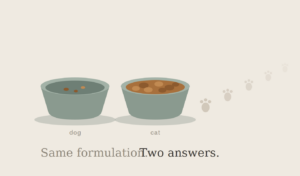
The same diet, offered to two species — and only one bowl comes back empty

Somewhere tonight a cat will walk away from a bowl of food that is nutritionally faultless. Every amino acid balanced against a published requirement, every micronutrient supplemented, digestibility measured and documented, the whole formulation defensible to any regulator who cares to ask. And the animal will sniff it, decline it, and sit down beside it.

That refusal is the most important data point in our industry, and it is the one we have organised ourselves least well to understand.

The petfood industry is entering one of the most consequential periods of innovation in its history. Insect meals, microbial biomass, precision-fermented ingredients, cultivated meat and novel plant proteins are no longer confined to research laboratories or niche launches; they are steadily becoming part of mainstream product development, and the regulatory frameworks are beginning to move with them. The conversation has understandably centred on sustainability, nutritional adequacy, ingredient security and environmental impact. These are important discussions, and they will continue to shape the future of companion animal nutrition.

Yet they all rest upon a deceptively simple assumption.

That the pet willingly eats the food.

More importantly, that it continues to do so, day after day, bowl after bowl, long after the novelty has worn off.

Perhaps this is where our industry should pause.

For decades, palatability has been recognised as an essential component of product development, but seldom as its defining strategic challenge. It has often been viewed as the final optimisation step — something applied after the formulation has been completed and before feeding trials begin.

That perspective may no longer be sufficient.

As we progressively reformulate with lower-meat diets and alternative proteins, palatability is moving from the end of the development process to its very centre. It is becoming the bridge between scientific innovation and commercial success. In human food, the barrier to novel protein is persuasion; you can argue a person into a lentil. In petfood, the barrier is engineering. The animal will eat the bowl or it will walk away, and no marketing budget has ever changed its mind.

Owners buy the first bag. Pets decide the second.

I want to set out five conversations I believe we should be having. I have views on all of them, and I have deliberately not concluded any of them, because the people best placed to answer are scattered across formulators, ingredient developers, panel operators and researchers who rarely find themselves in the same room.


Conversation One

Have we confused nutritional replacement with behavioural replacement?

The industry has made remarkable progress in demonstrating that many alternative proteins can contribute to nutritionally complete diets. Essential amino acids can be balanced. Micronutrients can be supplemented. Digestibility continues to improve. In many respects, the question of nutritional adequacy is becoming increasingly manageable.

But nutrition and feeding behaviour are not the same challenge.

Replacing the nutritional contribution of meat does not necessarily replace the biological signals that companion animals have evolved to associate with food.

For much of our industry’s history, meat has quietly performed several functions simultaneously. It has provided protein, energy and micronutrients, but it has also supplied free amino acids, nucleotides, animal fats, Maillard reaction precursors, volatile sulphur compounds and a great many other molecules that together create a sensory experience. We have rarely needed to separate these functions, because meat conveniently delivered them together.

Alternative proteins force us to do exactly that.

And here I find myself genuinely uncertain. If meat performs five jobs at once, which of them is load-bearing? I am not aware of published work that takes it apart — that holds the amino acid profile constant while removing the nucleotide contribution, or the reverse, and reports what the animal does. Within ZEST, Sinonin Biotech leads the assessment of mycoprotein biochemical and techno-functional properties and the development and testing of petfood prototypes, which is precisely the territory in which this question becomes practical rather than academic. I would be glad to be pointed towards work that has already answered it.

Meat does five jobs at once. We never asked which one mattered.

Perhaps the more interesting question is no longer whether alternative proteins can replace meat nutritionally.

Perhaps it is whether they can replace what meat communicates biologically.


Conversation Two

Is meat an ingredient, or a sensory language?

One of the unintended consequences of alternative proteins is that they oblige us to reconsider what meat actually contributes.

Perhaps meat is not simply an ingredient. Perhaps it is a remarkably efficient carrier of sensory information — free amino acids that shape taste perception; 5′-nucleotides generated by the post-mortem breakdown of muscle tissue and almost entirely absent from plant material; animal fats that yield characteristic aroma compounds under process heat; Maillard and Strecker products that depend on sulphur amino acids many plant proteins supply only sparingly; and, behind all of it, the post-ingestive reinforcement that quietly teaches an animal what to choose next week.

These are not merely chemical constituents. Together they form a biological language through which dogs and cats recognise food.

When we remove meat, we are not only changing the source of protein. We are changing that language.

We are not changing the protein. We are changing the language.

Equally, alternative ingredients arrive speaking their own. Plant proteins may contribute bitter peptides, green or grassy notes and anti-nutritional compounds. Insect-derived materials bring different textural and aromatic characteristics. Fermentation products introduce another profile again.

These are not flaws. They are simply a reminder that every ingredient communicates something, whether or not we designed it to.

The question is whether we understand those conversations well enough to conduct them deliberately.


Conversation Three

Are we designing for one animal, or two?

We speak of petfood palatability as though it were a single discipline. It may be closer to two.

Dogs, shaped by millennia of proximity to human settlements, display considerable dietary flexibility, and their food selection appears substantially odour-led. Cats remain obligate carnivores whose selection is more taste-dominant, whose format preferences are largely established around weaning, and whose sensory apparatus is tuned with unusual precision to animal-derived material.

One difference deserves to be stated plainly, because it is structural rather than a matter of degree. The gene encoding the sweet taste receptor subunit is non-functional in the cat.

Not diminished. Absent.

The cat’s sweet receptor is not weak. It is absent.

Which means that a considerable portion of the toolkit available for managing bitterness in lower-meat canine diets is simply unavailable in the species that is also more bitter-sensitive, more texture-rigid and more neophobic than the dog.

I have a particular interest in this problem, having spent a large part of my research career on enzymatic protein hydrolysis and on the bitterness that hydrolysis generates. When you cleave a protein you expose hydrophobic residues, and hydrophobic peptides read bitter; I published on the simultaneous desalting and debittering of whey protein hydrolysates in 2007, and returned to the influence of environmental conditions and substrate pre-treatment on whey protein hydrolysis in a review with Ulrich Kulozik a decade later. The chemistry is not mysterious. What I am far less certain about is what the industry is actually doing with it now, in cats, at commercial inclusion levels, without recourse to sweetness.

I suspect practice here is well ahead of publication. If it is, I would rather hear it from the people doing the work than speculate about it from the outside.

There is a further observation that has been treated, I think, as a procurement inconvenience when it may be scientifically interesting. Trial data compiled by FEDIAF suggests that dogs may favour black soldier fly larvae meal while cats favour yellow mealworm — a plain divergence with no settled explanation. Lipid profile? Chitin fraction? Something in the volatile signature that one species reads as food and the other does not?

If we cannot explain why two domestic species rank the same two insects differently, it is worth asking how confidently we can predict acceptance of anything genuinely novel.


Conversation Four

Are we designing formulations, or engineering preference?

Historically, palatability has been treated as a finishing operation. Formulate, extrude, dry, coat, validate. That workflow has served the industry exceptionally well.

But as meat inclusion declines, it may become increasingly difficult to separate formulation from palatability.

One observation illustrates this particularly well. In many dry petfoods, the overwhelming majority of the formulation passes through the extruder before a final coating stage delivers much of the product’s sensory identity — and frequently those coatings still rely on animal-derived fats, digests or hydrolysates.

This is not a criticism. These ingredients remain highly effective, and their continued use is entirely rational.

It does, however, illustrate the nature of the transition we are undertaking. In a good many formulations we have replaced meat as a nutritional ingredient while continuing to depend upon it as a sensory technology.

We replaced meat as a nutrient. We kept it as a flavour.

It also explains something we say too rarely. The coating step is what makes dry formats forgiving; it separates the base matrix from the sensory signal and gives us a stage at which to correct course. Wet formats offer no such separation. They must be intrinsically palatable, first time, with nothing applied afterwards to rescue them.

Which raises an uncomfortable practical question. If lower-meat dry dog food is approaching a solved problem, what is the honest status of lower-meat wet cat food? Is anyone close? Or have we collectively, and rather quietly, deprioritised the hardest quadrant because the easier three pay sooner?

And behind that, a broader one. Are we replacing proteins, or are we beginning to redesign the mechanisms through which companion animals recognise food?

If it is the latter, palatability can no longer be regarded as something added at the end of development. It becomes a design discipline from the outset.


Conversation Five

Are we measuring the right outcome?

The industry has long relied upon robust palatability methodologies, particularly paired preference testing, and these methods have served ingredient developers extremely well.

Yet the transition towards alternative proteins raises a question about what, exactly, we are measuring.

A two-bowl comparison is exceptionally sensitive to small formulation differences. That sensitivity derives from simultaneous presentation against a control — which is precisely what makes it invaluable during development, and precisely what makes it unlike any situation the animal will ever encounter at home.

Consider what that means for a genuinely novel diet. It is assessed on an unfamiliar aroma profile, at first exposure, in an animal whose neophobia is a feature of its biology rather than a defect in the product. Meanwhile the one mechanism that most favours reformulated diets, post-ingestive learning, requires repeated exposure to operate at all, and the design excludes it.

Commercial reality unfolds rather differently. Pets eat one food at home. Owners observe feeding behaviour across weeks and months. Confidence accumulates slowly. Repurchase follows repeated positive experience.

The trial rewards preference. The market rewards repurchase.

So let me ask the narrow version rather than the rhetorical one. Where is the ninety-day monadic comparison between an alternative-protein diet and its meat-based equivalent? I cannot find one published. If it exists, it deserves considerably more attention than it has received. If it does not, that absence tells us something about what we have chosen to measure, and what we have chosen not to look at.

Success depends less upon winning the first comparison than upon earning the next purchase.


Looking Ahead

The bowl is the only honest judge

The conversation around alternative proteins is usually presented as an ingredient story. It is equally a sensory story.

The companies that succeed over the coming decade may not be those with access to the newest protein technologies; many of those will become broadly available across the industry. The greater advantage may lie in understanding feeding behaviour more deeply than competitors — in integrating sensory chemistry, behavioural biology, process engineering, flavour science and nutrition into what might reasonably be called palatability engineering.

The term matters less than the shift in thinking it represents.

The industry has learnt how to formulate with meat. Its next task is learning how to formulate without relying upon it, while preserving the sensory experience that keeps pets returning to the bowl and owners returning to the shelf. That cannot be solved by nutrition alone, nor by flavour chemistry alone, nor by processing alone.

I have left these five conversations open on purpose. I am more interested in what the people running the trials and formulating the diets know than in restating what I think I know. If you are working on any of them — the deconstruction question, the feline bitterness problem, or the longitudinal data — I would rather have your answer than repeat my own.

We have spent a decade asking whether these proteins can nourish a dog or a cat.

The animal has been answering a different question all along.

A diet the animal refuses has an efficacy of zero.

Dr. rer. nat. habil. Dr. Seronei Chelulei CheisonLangwedel, Niedersachsen


Dr. rer. nat. habil. Dr. Seronei Chelulei Cheison is the founder and Chief Executive Officer of Sinonin Biotech GmbH, a biotechnology company focused on alternative protein and palatability enhancer innovation and application for petfood formulations. He formerly led alternative protein and palatant development projects at Mars Petcare, and spent close to two decades in academic research on enzymatic protein hydrolysis, holding a doctorate from Jiangnan University and a habilitation from the Technical University of Munich.

Sinonin Biotech GmbH is a partner in two consortia funded under the Circular Bio-based Europe Joint Undertaking: ZEST, on fungal fermentation of agricultural residues, and PROSCALE, on scalable microbial protein ingredients, which runs from September 2026 to August 2030.

Co-funded by the European Union under Grant Agreement No. 101157382 (ZEST) and Grant Agreement No. 101288362 (PROSCALE). Views and opinions expressed are however those of the author only and do not necessarily reflect those of the European Union or CBE JU. Neither the European Union nor the CBE JU can be held responsible for them.