Petfood Palatability and the Fresh-Kill Signal Cats Read as Prey
The Biological Signal
Why the cat at the bowl is not smelling meat. It is smelling a fresh kill, and the single molecule that tells it so is one the flavour industry has spent twenty-five years trying to bottle.

Cut a finger and bring it to your nose, and you will recognise at once a smell you have never been taught: sharp, metallic, faintly like wet iron. You did not learn it. It arrived with you. And it has a name, a single molecule, one of some thirty that gas chromatography can pull out of a drop of blood, and the only one your nose truly needs.
For a human being that smell is a curiosity, occasionally an alarm. For an obligate carnivore it is not a smell at all. It is an instruction.
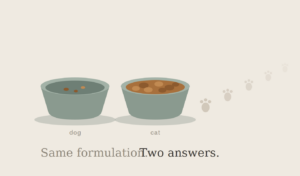
For decades the petfood industry has spoken of “meat flavour” as though a cat crossed the kitchen because it enjoyed the taste of meat, the way a person enjoys the taste of beef. That is a comfortable anthropomorphism and it is not what evolution built. The cat is not a small person with fur. It is a predator whose sensory apparatus was shaped by a single recurring problem, asked over millions of years and millions of kills: is this prey fresh enough to be worth eating?
That question is answered long before anything reaches the tongue. It is answered in the air.
I raise this now, and not as a curiosity, because the category is in the middle of the largest reformulation in its history. The industry is moving (under pressure from cost, from carbon, from supply, and from a genuine shift in what owners will buy) away from meat and toward alternative proteins: fungal biomass, single-cell protein, insect meal, and at the furthest edge, plant-based and outright vegan diets for animals that evolution designed around a carcass. I am not here to tell that movement it is wrong. Much of it is right, and some of it is overdue. I am here to name, precisely and early, the thing standing between it and the bowl.
Because the transition will not be decided by whether these proteins can nourish a cat. It will be decided by whether the cat recognises them as prey.
A word on how I mean to do it. In the first of these Friday conversations I set five questions on the table and closed none of them. This one moves differently (a single question, followed as far down as I can take it), but the discipline is the same. I do not intend to answer this one either. I intend to show you how deep it goes, name the people who could answer it, and leave it, on purpose, where a conversation can still reach it.
The cat is not a small person with fur. It is a predator asking one question: is this fresh enough to be worth eating?
The nose that threw things away
An omnivore’s senses are a compromise. They must find ripe fruit and reject unripe, detect sweetness and starch, weigh a hundred plant and animal foods against one another. The cat abandoned all of that. Somewhere on the way to obligate carnivory it lost the working sweet-taste receptor entirely: the gene is a pseudogene, a broken cassette, and it is why a cat is indifferent to sugar in a way no dog ever is. What the lineage saved on sugar it spent on meat. The equipment that survived is equipment for one job: to find, assess and commit to prey.
So when we sit down to reformulate that prey (to replace the animal tissue in the bowl with mycoprotein, with fermented biomass, with a protein a European hectare threw away), we are not merely swapping a nutrient. We are addressing a sensory system that was built, at the cost of everything it discarded, to detect the one thing we have taken out.
The molecule
When blood meets air, the fats within it begin to oxidise almost immediately. Lipid peroxidation is not exotic chemistry; it is the same family of reactions that turns fat rancid, running here in seconds rather than months. Among its products is an oxygenated aldehyde with an unwieldy name, trans-4,5-epoxy-(E)-2-decenal, mercifully shortened by the people who study it to E2D.
E2D is the character-impact compound of blood. Of the roughly thirty volatiles a machine finds in a blood sample, this is the one a trained human nose picks out as the metallic, blood-like note, a fact established not by the instrument, which nearly missed it, but by human panellists smelling the gas chromatograph’s output one peak at a time. It is extraordinarily potent. Human detection thresholds sit in the parts-per-trillion range; the mouse, for its own reasons, is more sensitive still.
And here is the detail that ought to reorganise how we think about the whole category: no open wound, no E2D. The molecule is not a property of meat. It is an event, with a clock. It appears when tissue is broken and blood meets oxygen (at the moment of the kill), and it is gone again as the chemistry moves on. It does not signal meat. It signals a fresh kill. What comes later, as flesh actually decays, is a wholly different and largely repellent set of volatiles. E2D is the top of the freshness curve, not the bottom of the rotten one.
It does not signal meat. It signals a fresh kill, and it is gone again before the meat has time to rot.
What the animals actually did
Between 2014 and 2017 a group of Scandinavian researchers did the experiment that turns this from chemistry into biology. They took pure E2D (no blood, just the single synthesised molecule) and painted it onto wooden logs, and gave it to captive predators. Siberian tigers, Asian and African wild dogs, South American bush dogs, later a pack of wolves. The animals sniffed, licked, bit, pawed and dragged the logs exactly as they did for a fresh kill. One molecule reproduced the response of the whole complex mixture. Present the same compound to a mouse and it does the opposite: avoidance, vigilance, retreat. The identical cue, read as dinner by the predator and as danger by the prey, across species that last shared an ancestor a very long time ago. The word the field uses is conserved, and it is the right one.
Now the honest edge of this, which the essay will not step around, because stepping around it is precisely the habit I am arguing against.
The tiger is a felid. The domestic cat is a felid. The lineage, the diet, the obligate carnivory are shared. It is a reasonable and probably correct inference that Felis catus reads E2D as the tiger does. But inference is not evidence, and I want to be exact about what I am and am not claiming. To the best of my search, no publicly published study has put a domestic cat in front of purified E2D, measured its investigation and its intake, and reported the number. I make the distinction on purpose. The great palatability houses run trials they never publish, and it is entirely possible the experiment has already been done behind a confidentiality wall and quietly priced into a product. What I can say is that it is not in the public record, not in the behavioural journals, which stopped at tigers, wolves and wild dogs; and not, I checked, in the flavour patents that first put a commercial value on this molecule, which rest their entire case on human tasters smelling the compound in water. The most commercially consequential species in the palatability business is absent from the one experiment that would matter most to it, at least anywhere the rest of us are allowed to read.
I would be glad to be shown the study I could not find. And if it truly is not there (if the number does not exist, or exists only where none of us can see it), then that absence is not a footnote. It is the conversation.
The most commercially consequential species in the whole business is missing from the one experiment that would matter most to it.
A word to the dog
Before anyone assumes this is a cat’s story alone: it is not. The clearest behavioural evidence for E2D comes from the dog family. The wolf, the domestic dog’s own ancestor, worked the scented logs as avidly as the tiger did, and three wild-dog species did the same.
E2D is not a feline signal. It is a carnivore signal, and the dog reads it plainly.
What differs is not whether the dog detects the kill, but how much rides on the detection. The dog is the better nose of the two, with more than twice the cat’s olfactory neurons, and it is an omnivore with the full five-taste palate, sweet included, and a working flexibility the cat traded away. It reaches acceptance by many roads. The cat reaches it by few: no sweet receptor, fewer taste buds, a narrower diet, a deeper neophobia. So the same molecule that is one appetite cue among several for the dog is, for the cat, closer to the whole case. I have told this through the cat not because the dog is unmoved, but because the cat is where a single wrong note is likeliest to end in a turned back and an untouched bowl. Solve the cat, the finickier customer, and you have cracked the hardest bowl in the business.
Why this is not another palatant story
The systems that carry the category today are genuinely good, and I will not pretend otherwise. Animal digests, hydrolysed proteins, the browning chemistry of cooking, these reproduce, with real skill, much of the flavour a cooked and digested meat delivers. They are the reason a modern coated kibble works at all, and I spent years of my own working life inside that toolkit. Nothing here displaces them.
But E2D is a different kind of message, and the difference is the point. A digest imitates cooked meat: the kitchen, the retort, the long warm chemistry of a meal. E2D imitates fresh prey: the wound, the moment, the kill. These are not two intensities of the same signal. They are two different sentences spoken to two different parts of the animal’s evolutionary memory: one about food that has been cooked, one about food fresh from the kill.
There is a practical consequence that formulators will recognise immediately. E2D is volatile and reactive; it would no more survive the heat of an extrusion barrel than a fragrance would survive a hot iron. You do not scent a shirt and then press it; you press it first and lay the scent on after. A signal like this could not be built into the dough. It would have to be delivered afterward (through the fat coat, the liquid palatant, the topcoat applied once the kibble had cooled), so that its message waited in the headspace the instant the bag was opened and the bowl was filled. Its job would not be nutrition. Its job would be the first sentence the animal reads before it has taken a step.
And is it? Is E2D, or some designed cousin of it, already sitting in a product on a shelf, doing exactly this? I do not know, and I will not pretend to. That is the honest edge of an outsider’s knowledge, and it is precisely the sort of thing I would rather ask in the open than guess at in private. If it is already there, then someone has been speaking the cat’s oldest language for years without saying so. If it is not, then the most potent word in that language is going spare.
The industry knew, and the regulator hesitated
None of this escaped the people whose business is flavour. More than two decades ago the flavour and fragrance house Givaudan patented the isomers of epoxydecenal specifically for their potency, in United States patents resting on the observation that the molecule’s handedness matters, that one optical form of the same compound carries more sensory punch than its mirror image. Even chirality, the difference between a left hand and a right, turns out to be something biology is reading. That is the level of detail the category has been prepared to pursue.
And yet the same molecule sits under a regulatory shadow. In the European Union, the flavouring 4,5-epoxydec-2-enal was assessed by EFSA and could not be cleared: it tested positive for genotoxicity in an in-vitro micronucleus assay, a result the follow-up in-vivo work confirmed in the liver, and the panel concluded it could not be evaluated as safe under the standard procedure. In 2017 it was removed from the EU list of permitted flavourings. That verdict was reached for human food, and petfood is a different regime with different exposures and different rules; one does not automatically carry to the other. But it is a caution written in ink, not pencil, and any honest account of E2D has to carry it too.
It is worth being exact about the two numbers involved, because they sit strikingly far apart. The signal a predator reads operates at the edge of physics: a cat’s fresh-kill cue is a matter of parts per trillion, picograms of the molecule in the air above the wound. The genotoxic flag, by contrast, was raised by feeding rats near-maximum-tolerated doses, in the region of three hundred milligrams per kilogram straight into the stomach, enough to leave necrosis in the liver. Between the concentration that carries the message and the concentration that does the damage lies a gap of many orders of magnitude, and the same chemical reactivity that lights up a genotoxicity assay in a dish is precisely what makes E2D a fleeting top-note in the world rather than a compound that lingers or accumulates. None of which clears it; the flag is real and I will not explain it away. But it does sharpen the question. The hazard was shown in a rodent liver, for a human additive, at a dose no palatant use would approach, in a species that is not the one eating the bowl.
Which leaves the honest account not with a verdict but with a gap in the evidence, and it is worth naming plainly. Is there a single published study of what E2D does in a cat, at the vanishing concentrations a cat would actually meet, rather than in a rat gavaged to its limit? If there is, I have not found it. And if there is not, then we are weighing a signal biology has used for millions of years against a hazard measured in the wrong species, by the wrong route, at ten orders of magnitude the wrong dose, and calling the balance settled. Is it?
Applied chemical ecology
Here is where the questions get harder, and I would rather leave them open than pretend I have closed them.
Modern palatant development, at its sharpest, is no longer flavour creation in the culinary sense, the art of making something taste nice. It looks more like applied chemical ecology: the deliberate use of signals evolution spent millions of years teaching an animal to obey. And if that is what the discipline has quietly become, then is the whole alternative-protein transition asking the wrong question of itself? We keep asking whether a fermented biomass can nourish a cat. Should we not be asking, first and far more urgently, whether it can convince one?
We keep asking whether a fermented biomass can nourish a cat. We should be asking whether it can convince it to eat.
Because a diet the animal refuses has an efficacy of zero, and the refusal is decided in the headspace above the bowl, in the first second, before a single requirement on the label has been tested.
Which brings the sharpest question to the table, the one that decides whether the vegan bowl is a biological dead end or merely an unsolved problem. Is the signal the cat is chasing an irreducible property of meat, something that exists only as long as the muscle does? Or is it a molecule, a single defined compound that forms wherever the right fats oxidise, and that a chemist could, in principle, build from feedstocks that never saw an animal? The science leans hard toward the second answer; the whole reason a company could patent E2D’s isomers is that it is a thing you can make. But if that is right, then where does it leave the argument the industry keeps having? Can the kill be written by a factory rather than a carcass? Can the instruction the cat obeys be sprayed onto a fungal kibble that a tiger’s ancestors would not recognise as food, and would the cat obey it anyway?
And there is a further turn to this that is worth holding onto, because it changes what the molecule is for. It would be easy to treat E2D as a beautiful but unreachable thing, a signal to admire and not use, especially with a regulator’s flag against the isolated compound. That would be the wrong lesson. E2D is not only the smell of a raw wound; it is also generated in situ, by heat, from polyunsaturated fatty acid precursors through ordinary oxidation chemistry. The fresh kill writes this word in seconds; heat can write it again from the fats. Which means the question was never “where do we buy the molecule,” but “what chemistry, and which precursors, let a food generate it for itself.” That is a thread for the conversations still to come, on how these signals form, from which precursors and on what timetable, and on the fats themselves, the most underrated players at the bowl.
I do not think those are rhetorical questions. I think they are unanswered, and I think the answers are worth more than another percentage point of protein.
And here is the one I most want to put to the people reading this, because I cannot answer it alone. We have been assuming the difficulty with insect and plant and fermented proteins is that they lack the signal, that there is no E2D in a mealworm, no fresh-kill note in a fungal biomass. But I do not actually know that, and neither, as far as I can find, does the public literature. Insects are lipid-rich and oxidise readily; the raw chemistry that makes E2D is present in them, even if the blood-metallic note has never been reported and their loudest volatiles point the nose somewhere else entirely, toward fish, earth and cheese. So the real question is open, and it is yours as much as mine. Is the signal simply absent from these materials? Or is there a different signal, one native to insects or microbes or plants, that a carnivore could be taught to read as readily as it reads the kill, that we have simply not gone looking for? If you know of such a molecule, or if you know that E2D is in fact hiding in one of these ingredients, I would genuinely like to be told.
Because strip the argument to its frame and this is what we have done. Evolution taught the cat to smell a fresh kill. We have answered by offering it a cooked meal, nutritionally balanced to the last milligram, and set it before an animal that has never cooked, never stored, never in its evolutionary life encountered food that was prepared rather than caught. We solved the gut and may have forgotten the nose. Have we built the perfect dinner and failed to announce it as dinner at all?
So let me put the essay’s own question back on its feet. Is the compound the point, or is the principle? If what an obligate carnivore reads can be decoded, defined and reproduced, then what exactly is standing between the plant-based movement, the alternative-protein developers and the palatant houses and the bowl they all want the animal to empty? Is it really whether the diet is complete, or whether it is credible to a nose calibrated by evolution to detect a fresh kill?
We have spent a generation asking whether these new proteins can nourish a cat.
The cat has been asking a different question the whole time. It has been asking whether something has just died. Can we learn to answer yes, and mean it, without a single animal having to?
Somebody should put a domestic cat in front of the molecule and publish what the bowl says. Until someone does, we are inferring the most important customer in the category from the behaviour of a tiger, and preparing to build the future of the bowl on that inference. Is that good enough?
I am asking.
And while we wait for the answer, here is the shape I think the question is taking.
We have spent twenty years learning how to make proteins without animals.
Perhaps we will spend the next twenty learning how to make them read, to the animal, like one.
Because the future does not belong to alternative proteins or to inclusive diets, as if the two were rivals. It belongs to an inclusive diet built around alternative proteins, and made credible to the creature that has to eat it. E2D is only one word in that language, and perhaps not even the word we will end up using. The point was never the molecule. The point is that the signal can be learned, and that the learning has an examiner.
And the bowl will answer before the laboratory does.
The thread this essay opens, how these signals form, from which precursors and on what timetable, is taken up in the third Friday Conversation: Meat Is More Than Protein.
Arshamian, A., Laska, M., Gordon, A.R., et al. (2017). A mammalian blood odor component serves as an approach–avoidance cue across phylum border, from flies to humans. Scientific Reports 7: 13635. doi:10.1038/s41598-017-13361-9
Buettner, A. & Schieberle, P. (2001). Aroma properties of a homologous series of 2,3-epoxyalkanals and trans-4,5-epoxyalk-2-enals. Journal of Agricultural and Food Chemistry 49(8): 3881–3884. Establishes trans-4,5-epoxy-(E)-2-decenal as the metallic, blood-like character-impact odorant. doi:10.1021/jf0104329
Pettersson, H., Amundin, M. & Laska, M. (2018). Attractant or repellent? Behavioral responses to mammalian blood odor and to a blood odor component in a mesopredator, the meerkat. Frontiers in Behavioral Neuroscience 12: 152. doi:10.3389/fnbeh.2018.00152
Li, X., Li, W., Wang, H., et al. (2005). Pseudogenization of a sweet-receptor gene accounts for cats’ indifference toward sugar. PLOS Genetics 1(1): e3. doi:10.1371/journal.pgen.0010003
Givaudan SA (inventors A. Daniher, S. Furrer, A. Goeke), US Patent 6,335,047 and continuation-in-part US Patent 6,451,366 (both granted 2002), Epoxydecenal isomers: isomeric forms of epoxydecenal with enhanced flavour potency, the enriched (−) optical isomer carrying greater sensory potency than its mirror image.
EFSA CEF Panel (2017). Scientific Opinion on Flavouring Group Evaluation 226, Revision 1 (FGE.226Rev1): genotoxicity data on 4,5-epoxydec-2(trans)-enal [FL-no. 16.071]. EFSA Journal 15(5): 4847. The substance raised a genotoxicity concern and could not be evaluated under the Procedure (and was subsequently removed from the EU flavourings list). doi:10.2903/j.efsa.2017.4847
Gassenmeier, K. & Schieberle, P. (1994). Formation of the intense flavour compound trans-4,5-epoxy-(E)-2-decenal in thermally treated fats. Journal of the American Oil Chemists’ Society 71(12): 1315–1319. Establishes that E2D forms on heating from the hydroperoxides of linoleic acid. doi:10.1007/BF02541347
Dr. rer. nat. habil. Dr. Seronei Chelulei Cheison is the founder and Chief Executive Officer of Sinonin Biotech GmbH, a biotechnology company focused on alternative protein and palatability enhancer innovation and application for petfood formulations. He formerly led alternative protein and palatant development projects at the Mars Petcare Global Innovation Centre in Verden, and spent close to two decades in academic research on enzymatic protein hydrolysis, holding a doctorate from Jiangnan University and a habilitation from the Technical University of Munich.
Sinonin Biotech GmbH is a partner in two consortia funded under the Circular Bio-based Europe Joint Undertaking: ZEST, on fungal fermentation of agricultural residues, and PROSCALE, on scalable microbial protein ingredients, which runs from September 2026 to August 2030.
Co-funded by the European Union under Grant Agreement No. 101157382 (ZEST) and Grant Agreement No. 101288362 (PROSCALE). Views and opinions expressed are however those of the author only and do not necessarily reflect those of the European Union or CBE JU. Neither the European Union nor the CBE JU can be held responsible for them.